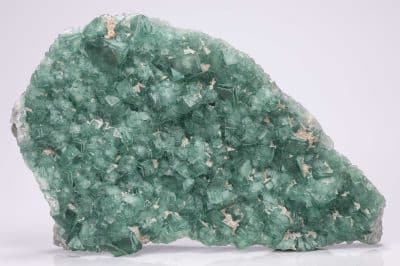
Pronounced hopper-style stair-step crystal growth with deep terraces
Distinct tiered “tower” silhouette with stacked geometric platforms
Vivid iridescent color shift across greens, golds, violets, and blues
Crisp right-angle edges and strong linear ribbing along multiple faces
High-contrast metallic sheen with mirror-like light play from different angles
Exact specimen shown – one of a kind
Specimen Details
Weight
2.62 oz (74.2 g)
Size
1.97 x 1.97 in (5 x 5 cm)
Made In
New Zealand
Crystal Description
This New Zealand–made bismuth crystal specimen features bold hopper-style growth, forming crisp stair-step terraces and layered geometry in a sculptural, tower-like profile. Its surface displays intense iridescent color that shifts through greens, golds, violets, and blue tones as the angle and light change. Read More →
The structure is defined by sharply recessed terraces and clean right-angle edges, creating strong dimensional depth and a distinctly architectural look. Multiple stacked platforms and interlocking steps give the piece a structured, cityscape-like presence from every side.
Under light, the specimen shows vivid rainbow iridescence created by a natural surface oxidation layer. Color bands move across the stepped faces, with metallic greens and golds shifting into magenta and violet flashes as you rotate the specimen.
Balanced between crisp geometry and dramatic color, this is a compact but high-impact display piece with strong reflective contrast and finely defined hopper patterning. This listing is for the exact specimen shown in the photos.
Click/Tap Buttons to Jump to Section
Bismuth Origin & Formation
Bismuth is a metallic chemical element with the symbol Bi and atomic number 83. While Bismuth does occur naturally in the Earth as native metal and within mineral compounds, it rarely forms well-defined crystals in nature due to the introduction of impurities (other minerals).
The striking, geometric “hopper” crystals most people associate with Bismuth are created through a man-assisted crystallization process. These crystals are grown by melting high-purity Bismuth metal and allowing it to cool slowly under controlled conditions.
As the molten metal cools, the crystal edges grow more rapidly than the center, producing the characteristic stepped, staircase-like structure. The vibrant rainbow colors form naturally as a thin oxide layer develops on the surface during cooling.
These crystals are not dyed or artificially colored, but they are not naturally occurring formations either. They represent a fascinating intersection of natural elemental properties and human-guided crystal growth.
Bismuth is known for several unusual physical characteristics. It is highly diamagnetic, meaning it strongly repels magnetic fields, and it has very low thermal conductivity compared to most metals.
The hopper crystal structure arises from Bismuth’s rhombohedral atomic lattice, which favors rapid edge growth under specific cooling conditions.
Bismuth is commonly associated with transformation and change. Its striking structure and vivid coloration symbolize movement, adaptation, and growth during periods of transition.
This element is often worked with to promote balance and harmony, helping align different aspects of the self and encourage emotional integration.
Bismuth is also linked with creativity and imagination. Its geometric form is thought to stimulate new ideas, problem-solving, and innovative thinking.
Many people associate Bismuth with energetic protection, believing it helps release emotional blockages and shield against negative influences. It is sometimes used in meditation practices aimed at spiritual connection and expanded awareness.
While not a naturally occurring crystal formation, Bismuth’s unique properties and visually expressive form make it a compelling tool for symbolic and reflective work focused on transformation, vitality, and self-exploration.



 Guaranteed Safe Checkout