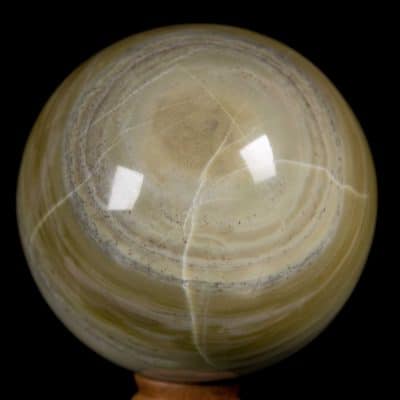
Weight – (without base) 43.9 gm’s
Dimensions – (without base) 2.232″ x 1.473″ long/wide (5.669 x 3.742 cm’s)
Country of Origin – Mexico



NZD $29.00
SKU: M1276
This natural Danburite Crystal Cluster with Pyrite inclusion for sale has a milky white color but still has amazing luster! Tiny pieces of Pyrite are embedded in the bottom of this specimen.
In stock
Use the tabs below to explore crystal origins, geological details, crystal care guidance, and metaphysical insights.
Weight – (without base) 43.9 gm’s
Dimensions – (without base) 2.232″ x 1.473″ long/wide (5.669 x 3.742 cm’s)
Country of Origin – Mexico
Click/Tap Buttons to Jump to Section
Danburite is a calcium boron silicate mineral prized for its clarity, gentle coloration, and refined crystal form. While it occurs in several localities worldwide, the most sought-after specimens—particularly gemmy, terminated pink Danburite—are sourced from Mexico. These crystals are admired for their high transparency, soft peach-to-pink hues, and elegant terminations.
Danburite typically forms in hydrothermal environments, often associated with minerals such as calcite, quartz, and fluorite. Its natural clarity and subtle coloration contribute to its reputation as a crystal of purity, refinement, and elevated awareness.
Because of its relatively limited availability in fine, undamaged terminations, high-quality Danburite specimens are increasingly valued by both collectors and practitioners.
Danburite is composed of calcium boron silicate and crystallizes in the orthorhombic crystal system. It commonly forms prismatic crystals with well-defined terminations and excellent transparency.
The mineral develops under relatively stable geological conditions, which contribute to its clarity and structural integrity. Danburite is harder than many visually similar crystals, making it suitable for both specimen display and careful handling.
| Property | Value |
|---|---|
| Mineral Species | Danburite |
| Chemical Formula | CaB2(SiO4)2 |
| Crystal System | Orthorhombic |
| Hardness (Mohs Scale) | 7 – 7.5 |
| Luster | Vitreous |
| Transparency | Transparent to translucent |
| Typical Formation | Hydrothermal environments |
⚠️ Handling:
Danburite is relatively durable, but its clear terminations can chip if knocked. Lift from the base and avoid pressure on points.
🧼 Cleaning:
Water-safe for brief rinsing. Avoid prolonged soaking, salt, or ultrasonic cleaners. Dry thoroughly.
☀️ Light:
Generally light-stable. Normal display conditions are suitable.
📦 Storage & Display:
Store separately from harder minerals to preserve clarity and surface polish. Stable display is recommended.
Click/Tap Buttons to Jump to Section
Pyrite has been known and worked with since ancient times and was used by many early civilizations for both decorative and practical purposes. Its metallic luster and golden color earned it the nickname “Fool’s Gold,” though Pyrite has always been far more than a simple look-alike.
The name Pyrite comes from the Greek word pyr, meaning fire, as sparks are produced when it is struck against steel or stone. This property made Pyrite an important early fire-starting material long before modern ignition tools existed.
Pyrite commonly forms in cubes, pyritohedrons, clusters, and massive aggregates. Perfect cubic crystals with sharp edges are among the most visually striking mineral forms found in nature.
Pyrite is frequently found growing alongside other minerals such as Quartz, Fluorite, Calcite, Lapis Lazuli, and various sulfides. In many cases, Pyrite enhances the visual and energetic appeal of the host crystal it forms with.
From a metaphysical perspective, Pyrite has long been associated with vitality, strength, and resilience, reflecting its robust and enduring physical structure.
Pyrite is an iron sulfide mineral with the chemical formula FeS₂. It crystallizes in the isometric (cubic) crystal system and is one of the most abundant sulfide minerals on Earth.
It forms in a wide range of geological environments including hydrothermal veins, sedimentary deposits, metamorphic rocks, and coal seams. Pyrite can grow slowly over long periods, producing exceptionally well-formed crystals.
| Property | Value |
|---|---|
| Mineral Species | Pyrite |
| Chemical Formula | FeS₂ |
| Crystal System | Isometric (Cubic) |
| Hardness (Mohs) | 6 – 6.5 |
| Luster | Metallic |
| Color | Brassy yellow |
| Common Forms | Cubes, clusters, massive |
Although visually similar to gold, Pyrite is much harder and more brittle, breaking rather than bending under stress.
🧼 Cleaning:
Do not soak Pyrite in water. Moisture can cause oxidation over time. Clean gently with a dry or slightly damp cloth and dry immediately.
📦 Storage:
Store Pyrite in a dry environment, ideally with airflow. Avoid sealed damp containers.
☀️ Light & Handling:
Pyrite is light-stable but should be handled with care to avoid chipping sharp edges.
Flat Rate Shipping of only $6 – $9 USD equivalent, add as many items as you like!
 Guaranteed Safe Checkout