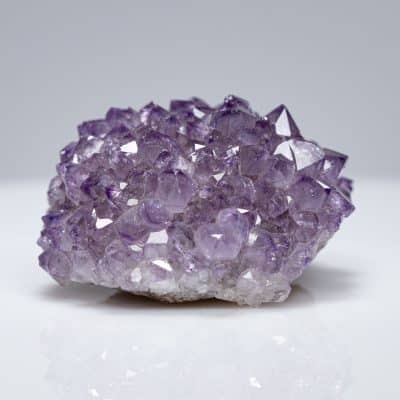
| Specimen Details | |
|---|---|
| Weight | (without base) 19.3 oz’s – 547 g |
| Dimensions | (without base) 4.33″ x 4.1″ long/wide (11 x 10.4 cm’s) |
| Country of Origin | Brazil |
Smoky Amethyst Elestial Quartz Crystal
USD $185.00
SKU: E363
This Smoky Amethyst Quartz Crystal has fantastic elestial form and definition and has a wonderful mixture of both Smoky and Amethyst Colors. The Amethyst colors are best viewed shining a light through the crystal. The removable base featuring New Zealand Paua shell comes with the crystal! This specimen is in excellent condition. Check out the video just above for the best view of this awesome specimen!
In stock
Use the tabs below to explore crystal origins, geological details, crystal care guidance, and metaphysical insights.
Click/Tap Buttons to Jump to Section
Smoky Quartz Origins & Background
Smoky Quartz is one of the most practical, grounding, and widely used Quartz varieties and is often considered a default crystal in healing layouts. Its naturally smoky coloration ranges from light translucent brown through to deep smoky grey and near-black tones.
Smoky Quartz forms when Clear Quartz is exposed to natural radiation within the Earth over long periods, causing aluminum impurities in the crystal lattice to change the way light is absorbed. This process is entirely natural and produces a grounding, stabilizing crystal with remarkable resilience.
Morion Crystals are a very dark to opaque, nearly black variety of smoky quartz, a brownish-to-black form of quartz crystal colored by natural radiation – it must still be translucent to be termed a “Morion”.
Smoky Quartz may occur as single points, clusters (rare), Elestial formations, Phantoms, and on very rare occasions Cathedral formations. It can also combine naturally with other Quartz varieties such as Amethyst and Citrine, creating powerful hybrid crystals.
Smoky Quartz Geological Information
Smoky Quartz is composed of silicon dioxide (SiO₂) and crystallizes in the trigonal crystal system, like all Quartz. Its coloration is caused by natural ionizing radiation acting on trace aluminum within the crystal structure.
True Smoky Quartz remains at least partially translucent. Completely opaque specimens are extremely rare and should be treated with caution, as much material on the market is artificially heat-treated Clear Quartz.
Common Geological Forms
- Single terminated points
- Elestial and skeletal forms
- Phantom inclusions
- Rare clusters and Cathedral formations
Physical Properties
| Property | Value |
|---|---|
| Mineral Species | Quartz (Smoky variety) |
| Chemical Formula | SiO₂ |
| Crystal System | Trigonal |
| Hardness (Mohs Scale) | 7 |
| Luster | Vitreous |
| Transparency | Translucent to transparent |
| Defining Feature | Natural radiation-induced coloration |
Important Trade Note
A significant amount of Smoky Quartz on the market is artificially heated Clear Quartz. Majestic Quartz goes to great lengths to only natural Smoky Quartz.
Smoky Quartz Crystal Care & Ownership Advice
⚠️ Handling:
Smoky Quartz is durable and well suited for frequent handling and healing work.
🧼 Cleaning:
Water-safe for brief rinsing. Avoid prolonged soaking if inclusions or fractures are present. Dry thoroughly.
☀️ Light:
Prolonged intense sunlight may gradually fade color in some specimens.
📦 Storage & Display:
Smoky Quartz performs best when actively used rather than stored away. Ideal for daily grounding and protection.
Click/Tap Buttons to Jump to Section
Elestial Quartz Origins & Background
Elestial Quartz—sometimes referred to as Elestial Crystals—are among the most complex and information-rich Quartz formations known. While Elestials have been found in several countries including India, Australia, Africa, and the United States, the most significant and consistent source is Brazil, specifically the state of Minas Gerais.
Minas Gerais is an immense and intricate mining region, consisting of thousands of small, often hand-worked mines spread across a wide area. Within this region, true Elestial Quartz originates from a remarkably localized source—essentially a single large hill. Elestials occur in small to medium-sized pockets, and each pocket produces crystals with unmistakable family traits.
One of the most fascinating aspects of Elestial Quartz is that even when two pockets are found only feet apart, the crystals from each pocket will often display distinctly different growth signatures, surface features, and internal character. This phenomenon highlights the extraordinary adaptability of Elestial Quartz as it responds to subtle variations in geological and energetic conditions during formation.
This extreme variability is a defining hallmark of Elestials and contributes greatly to their reputation as crystals of adaptability, integration, and multidimensional awareness.
Elestial Quartz Geological Information
Elestial Quartz is composed of silicon dioxide (SiO₂) and crystallizes in the trigonal crystal system, like all Quartz. What distinguishes Elestials is not chemistry, but an exceptionally complex growth process involving repeated phases of expansion, contraction, dissolution, and regrowth.
Elestial crystals commonly exhibit:
- Skeletal or layered growth (onion-like structure)
- Deep etching and terracing
- Multiple terminations and recessed faces
- Internal veils, windows, and cavities
Many Elestials grow in skeletal form, meaning the crystal develops in layers rather than completing each growth phase uniformly. In some specimens, outer layers fully enclose earlier stages, allowing the observer to gaze through successive layers from the outside inward. In others, the layers remain incomplete, creating stepped surfaces that can be both seen and felt.
Some Elestial Quartz crystals also contain moving water bubbles, known as Enhydro Crystals. These trapped ancient fluids are geological records of the environment at the time of formation.
Etching is common, though not universal, in Elestial Quartz. These etched patterns often resemble complex symbols or glyph-like markings created by selective dissolution during growth pauses.
Physical Properties
| Property | Value |
|---|---|
| Mineral Species | Quartz (Elestial formation) |
| Chemical Formula | SiO₂ |
| Crystal System | Trigonal |
| Hardness (Mohs Scale) | 7 |
| Luster | Vitreous to matte (etched areas) |
| Transparency | Transparent to translucent |
| Common Features | Skeletal growth, etching, internal chambers |
Elestial Quartz Crystal Care & Ownership Advice
⚠️ Handling:
Elestial Quartz often features deep etching, layered growth, and delicate recesses. Handle gently and avoid impacts, especially on stepped or skeletal areas.
🧼 Cleaning:
Water-safe for brief rinsing. Avoid prolonged soaking, ultrasonic cleaners, or chemical agents, which may lodge in etched surfaces. Dry thoroughly.
☀️ Light:
Light-stable under normal conditions. Specimens with enhydros should be protected from extreme temperature changes.
📦 Storage & Display:
Display securely where airflow and vibration are minimal. Store padded and separate from other crystals to protect intricate surfaces.
Click/Tap Buttons to Jump to Section
Amethyst Origins & Background
Amethyst has been valued across cultures for thousands of years for its rich violet coloration and its association with clarity, balance, and composure. The name Amethyst originates from the Greek word amethystos, meaning “not intoxicated,” reflecting an ancient belief that the stone helped maintain clear thinking and moderation.
Historically, Amethyst was considered a stone of royalty and spiritual authority. It adorned crowns, rings, and ceremonial objects in Ancient Greece and Rome and later throughout medieval Europe. Its purple color was rare and strongly associated with wisdom, restraint, and elevated status.
Significant Amethyst deposits are found in Brazil, Uruguay, Zambia, Madagascar, and Russia. Each locality produces crystals with distinctive growth habits, color zoning, and internal features, making provenance an important consideration for collectors and natural crystal enthusiasts.
Amethyst’s coloration develops through trace amounts of iron within the Quartz lattice combined with natural irradiation and geological heating over extended time periods. This process often creates layered growth zones that contribute to the depth and visual complexity seen in higher-quality specimens.
Some Amethyst crystals display structural growth features such as internal windows, phantoms, record keepers, and time-link faces. These are physical indicators of crystal formation traits and are valued for both the insight they provide into natural growth processes and to possible Metaphysical propoties.
Amethyst Geological Information
Amethyst is a violet variety of Quartz (Silicon Dioxide – SiO₂) that typically forms within cavities, veins, and geodes in igneous and metamorphic rock environments. Crystals usually grow as hexagonal prisms with pointed terminations.
The purple coloration results from trace iron incorporated into the Quartz structure combined with natural irradiation from surrounding rock. Subsequent geological heating stabilizes these color centers, producing hues that range from pale lavender to deep royal purple.
Amethyst commonly forms in volcanic environments, particularly within gas cavities of cooling basalt flows. Over millions of years, silica-rich fluids crystallize slowly, allowing layered growth and the development of internal zoning and structural features.
Common Geological Occurrences
- Volcanic basalt cavities and geodes
- Hydrothermal Quartz veins
- Metamorphic rock environments
Physical Properties
| Property | Value |
|---|---|
| Mineral Species | Quartz (Amethyst variety) |
| Chemical Formula | SiO₂ |
| Crystal System | Trigonal |
| Hardness (Mohs Scale) | 7 |
| Luster | Vitreous |
| Transparency | Transparent to translucent |
| Fracture | Conchoidal |
Amethyst Crystal Care & Ownership Advice
⚠️ Sunlight & Heat:
Prolonged exposure to intense sunlight or heat may cause some Amethyst specimens to fade over time. For long-term preservation, extended placement in direct sunlight is best avoided.
✋ Handling:
Amethyst is relatively durable, but sharp impacts can chip crystal points or edges. Handle specimens gently, especially clusters and terminated points.
🧼 Cleaning:
Clean Amethyst using lukewarm water and a soft brush. Avoid harsh chemicals, ultrasonic cleaners, or abrasive tools, which may damage crystal surfaces.
📦 Storage & Display:
Prolonged exposure to intense sunlight or high heat may cause some Amethyst specimens to fade over time.
For long-term preservation, extended placement in direct sunlight is best avoided. Indirect light or filtered natural light is ideal for display. This preserves color while still allowing the crystal’s natural beauty to be appreciated.
Flat Rate Shipping of only $6 – $9 USD equivalent, add as many items as you like!
- 30 days easy returns
- Faster shipping also available
 Guaranteed Safe Checkout
Related Crystal Specimens
-
 USD $42.00
 -
USD $40.00
-
USD $29.00
-
USD $36.00