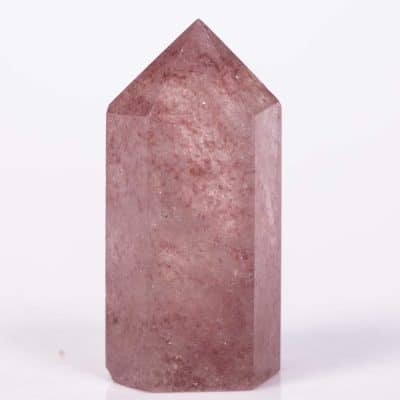
The deep blue hues range from teal to inky navy, with subtle mineral variations that give the piece visual depth and organic character.
Its flowing flame silhouette and smooth polish create a balanced blend of sculptural elegance and natural presence.
A striking Brazilian apatite specimen well-suited for display, photography, or a curated crystal collection.
Click/Tap Buttons to Jump to Section
Apatite Origins & Background
Apatite is a group of phosphate minerals rather than a single mineral species. It is best known for its wide range of colors and its important role in both natural biological systems and modern industry.
Apatite occurs in a broad spectrum of colors, including blue, green, yellow, teal, violet, pink, and colorless. Blue and green varieties are the most commonly encountered in the crystal trade, while yellow and pink Apatite are comparatively rarer.
The name Apatite comes from the Greek word apate, meaning “to deceive.” This refers to Apatite’s tendency to resemble other minerals such as Beryl, Tourmaline, or Peridot, which historically caused confusion among early mineralogists.
Apatite occurs both as well-formed crystals and in massive form. While transparent crystals are highly prized, much of the Apatite available on the market is sourced from massive deposits and cut or polished to reveal its color and internal glow.
Major sources of Apatite include Brazil, Mexico, Madagascar, Russia, Canada, and Myanmar.
Apatite is a calcium phosphate mineral with the general chemical formula Ca₅(PO₄)₃(F,Cl,OH). The presence of fluorine, chlorine, or hydroxyl groups creates different Apatite varieties, including Fluorapatite, Chlorapatite, and Hydroxylapatite.
Apatite commonly forms in igneous, metamorphic, and sedimentary environments. It is a primary component of phosphate rock and plays a crucial role in Earth’s phosphorus cycle.
Crystalline Apatite typically forms as hexagonal prismatic crystals, sometimes with well-defined terminations. These crystals may be transparent to translucent and are often small but sharply formed.
Massive Apatite occurs as compact, granular material without distinct crystal faces. This material is frequently cut and polished for decorative, metaphysical, and lapidary use.
Apatite is often regarded as a crystal that helps reorganize chaos into order across the spiritual, physical, and etheric levels. By encouraging these aspects to work in synergy, Apatite supports a sense of flow, clarity, and balanced progress in daily life.
This crystal promotes self-confidence and certainty in decision-making. Many people work with Apatite when they feel scattered, overwhelmed, or uncertain, as it encourages clear prioritization and purposeful action.
Apatite is frequently described as a tonic for modern-age challenges. It is traditionally associated with cutting through distraction, misinformation, and media-driven noise, helping one remain focused on what is genuinely meaningful.
On a physical and energetic level, Apatite has long been associated with calcium metabolism. Symbolically, calcium represents structure and support, and Apatite is often worked with to strengthen one’s sense of inner framework and resilience.
When used as an elixir in traditional crystal practices, Apatite is believed to support the body’s ability to cope with environmental stressors, promote muscle tone and elasticity, and encourage balance within the skeletal system.
Practical & Everyday Uses
Apatite is well suited for study, planning, and decision-heavy environments. Keeping it near a workspace can help maintain focus, reduce mental clutter, and support follow-through on goals.
Apatite Crystal Pairings & Synergy
Apatite pairs well with stones that support clarity, grounding, and confidence.
It is often combined with Clear Quartz
for amplification, Smoky Quartz
for grounding,
and Fluorite
for mental clarity and organization.
Apatite Cleansing & Charging — Safe Methods First
⚠️ Important:
Apatite is softer than Quartz and should be treated gently.
Water safety:
Apatite is not recommended for prolonged soaking. If rinsing is used, keep it brief and dry thoroughly.
Recommended crystal-safe methods:
Sound: singing bowls, bells.
Moonlight: gentle overnight exposure.
Intention / meditation: visualization or breathwork.
Selenite plate: dry cleansing method.
If unsure:
choose dry or non-contact cleansing methods.



 Guaranteed Safe Checkout