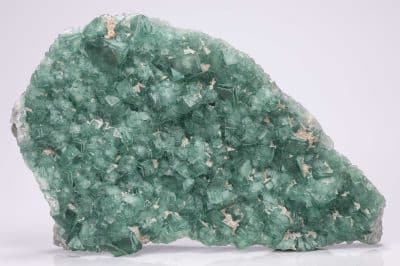
Well-developed nailhead terminations with stepped growth
Strong metallic contrast between calcite, hematite, and pyrite
Clustered formation with multiple intergrown crystals
Exact crystal shown – one of a kind
Specimen Details
Weight
27.69 oz (785 g)
Size
5.71 x 4.72 in (14.5 x 12.0 cm)
Origin
China
Crystal Description
This nailhead calcite cluster from China presents a dense, well-integrated formation of intergrown crystals accented by naturally associated pyrite. The calcite displays classic nailhead morphology, with stepped terminations rising from a shared base and creating a strong sense of structure and cohesion across the cluster.
Hematite inclusions are visible within the calcite, imparting warm reddish-brown to silvery tones that contrast with the lighter calcite body. These inclusions are unevenly distributed, adding visual depth and emphasizing individual crystal boundaries without overwhelming the overall clarity of the formation.
Bright metallic pyrite crystals are naturally attached along select surfaces, introducing sharp cubic geometry and reflective highlights. The pyrite provides a striking textural and color contrast against the matte-to-satin calcite faces and darker hematite inclusions.
The cluster structure is compact yet visually layered, with multiple terminations oriented at varying angles. This creates a dynamic surface profile that remains balanced and intentional, making the specimen engaging from multiple viewing perspectives.
Nailhead calcite formations are valued for their distinctive stepped growth and architectural terminations, and this specimen clearly demonstrates those traits across its clustered structure.
This listing is for the exact crystal shown. A one-of-a-kind nailhead calcite cluster with hematite inclusions and natural pyrite accents, offering strong mineral contrast, solid formation integrity, and collector-grade visual interest.
Click/Tap Buttons to Jump to Section
Pyrite Origins & Interesting Facts
Pyrite has been known and worked with since ancient times and was used by many early civilizations for both decorative and practical purposes. Its metallic luster and golden color earned it the nickname “Fool’s Gold,” though Pyrite has always been far more than a simple look-alike.
The name Pyrite comes from the Greek word pyr, meaning fire, as sparks are produced when it is struck against steel or stone. This property made Pyrite an important early fire-starting material long before modern ignition tools existed.
Pyrite commonly forms in cubes, pyritohedrons, clusters, and massive aggregates. Perfect cubic crystals with sharp edges are among the most visually striking mineral forms found in nature.
Pyrite is frequently found growing alongside other minerals such as Quartz, Fluorite, Calcite, Lapis Lazuli, and various sulfides. In many cases, Pyrite enhances the visual and energetic appeal of the host crystal it forms with.
From a metaphysical perspective, Pyrite has long been associated with vitality, strength, and resilience, reflecting its robust and enduring physical structure.
Pyrite is an iron sulfide mineral with the chemical formula FeS₂. It crystallizes in the isometric (cubic) crystal system and is one of the most abundant sulfide minerals on Earth.
It forms in a wide range of geological environments including hydrothermal veins, sedimentary deposits, metamorphic rocks, and coal seams. Pyrite can grow slowly over long periods, producing exceptionally well-formed crystals.
Physical Properties
Property
Value
Mineral Species
Pyrite
Chemical Formula
FeS₂
Crystal System
Isometric (Cubic)
Hardness (Mohs)
6 – 6.5
Luster
Metallic
Color
Brassy yellow
Common Forms
Cubes, clusters, massive
Although visually similar to gold, Pyrite is much harder and more brittle, breaking rather than bending under stress.
Pyrite is a powerful energizing and grounding mineral, especially valued for restoring vitality after periods of physical, emotional, or mental burnout. Its strong iron-based structure gives it a stabilizing yet invigorating presence.
Practical Ways to Work with Pyrite
Burnout Recovery & Energy Boosting Place Pyrite on the solar plexus while lying down. Breathe slowly and visualize golden energy grounding into the body. This is particularly effective for exhaustion, low motivation, and depleted personal energy.
Grounding the Gold Ray Pyrite is exceptional at grounding higher vibrational energies into the physical body. Point or touch crystals such as Citrine or Topaz against Pyrite to anchor their golden ray energies into practical, usable form.
Daily Carry for Resilience Carrying Pyrite during demanding periods helps maintain stamina, emotional steadiness, and confidence when responsibilities are high.
Physical & Emotional Support
Traditionally, Pyrite is associated with:
Supporting digestion and metabolism
Assisting blood health and circulation
Relieving depression and emotional fatigue
Encouraging regeneration and recovery
Its grounding nature helps convert scattered or depleted energy into strength and forward momentum.
Pyrite Crystal Pairings & Synergy
Pyrite works exceptionally well with Citrine for abundance and optimism, Topaz for clarity and manifestation, and Black Tourmaline to maintain grounding during high-energy work.
Pyrite is also frequently found naturally combined with Quartz, Fluorite, and Lapis Lazuli, enhancing the functional qualities of those stones.
Pyrite Cleansing & Energetic Maintenance
Recommended methods:
Sound cleansing
Smoke cleansing
Placement on Selenite
Intentional reset through breath and focus
Important: Avoid water cleansing to preserve both the physical integrity and energetic clarity of Pyrite.
Summary
Pyrite is a multi-talented mineral offering grounding, vitality, resilience, and regenerative support. Its ability to anchor high-frequency energies into the physical body makes it a valuable companion for modern life, especially during periods of high demand and transformation.
Hematite is one of the most important and widely distributed iron minerals on Earth. Its name derives from the Greek word haima, meaning “blood,” referencing the reddish streak Hematite produces when powdered—despite often appearing metallic gray or black in solid form.
Hematite has been used by humans since prehistoric times for pigments, tools, ceremonial objects, and grounding talismans. Today, it remains prized both as a mineral specimen and as a practical stone for grounding and focus.
Major sources of Hematite include Brazil, Australia, South Africa, England, Canada, and the United States. It occurs in massive, botryoidal, tabular, and crystalline forms, as well as polished disks, pendants, and beads.
Hematite is an iron oxide mineral with the chemical formula Fe₂O₃. It crystallizes in the trigonal crystal system and forms in a wide range of geological environments, including sedimentary, metamorphic, and igneous settings.
Hematite is one of the primary ores of iron and plays a major role in Earth’s geologic and industrial history. It often forms alongside Quartz, Magnetite, Goethite, and other iron-rich minerals.
Physical Properties
Property
Value
Mineral Species
Hematite
Chemical Formula
Fe₂O₃
Crystal System
Trigonal
Hardness (Mohs Scale)
5–6
Luster
Metallic to earthy
Color
Steel-gray, black, reddish-brown
Streak
Reddish-brown
Density
High
Structural Notes
Hematite’s density and iron-rich composition give it a pronounced physical “weight,” which contributes to its long-standing association with grounding and stability.
Hematite is traditionally regarded as one of the most powerful grounding and stabilizing minerals available. Its energy is dense, anchoring, and protective—bringing awareness firmly into the physical body.
Grounding & Physical Presence
Hematite is commonly used to:
Ground excess mental or emotional energy
Stabilize scattered focus
Encourage presence and embodiment
It is particularly helpful when one feels ungrounded, overwhelmed, or mentally overextended.
Radiation & Modern Environment Support (Traditional Use)
Hematite has long been regarded as a strong ally against what is traditionally described as “harmful environmental energies,” including unionized radiation from electronic equipment.
Practical Exercise — Workspace Grounding
Wear Hematite as a disk or pendant so it rests against the skin.
Use while working on or around computers or electronic devices.
Notice increased stamina and reduced energetic drain.
This practice is traditionally believed to saturate the aura with stabilizing energy, helping maintain vitality in high-tech environments.
Focus, Confidence & Mental Endurance
Hematite supports sustained focus on difficult or demanding tasks. It is often used when concentration, discipline, and follow-through are required without burnout.
Blood & Vital Energy Associations (Traditional)
In traditional crystal systems, Hematite is associated with blood cleansing and circulation, reflecting its iron-rich nature. When used symbolically or energetically, it is linked with strengthening vitality and physical resilience.
As an elixir, Hematite is traditionally believed to intensify these effects; however, elixir use should always be approached with care and informed practice.
Hematite Crystal Pairings & Synergy
Hematite pairs exceptionally well with grounding and protective stones.
It works especially well alongside Black Tourmaline for reinforced grounding, Clear Quartz to maintain clarity while grounded, and Smoky Quartz for additional stabilization.
Hematite Cleansing & Charging — Simple & Grounded
⚠️ Important: Hematite does not require frequent cleansing and prefers minimal interference.
Recommended crystal-safe options:
Sound: low, steady tones.
Earth contact: place near soil or plants (not buried).
Rest: allow downtime between intensive use.
Summary
Hematite is a deeply grounding, stabilizing, and energizing mineral. By anchoring awareness into the physical body, supporting focus, and protecting against energetic drain, it serves as a powerful ally for modern life—especially in high-demand, technology-heavy environments.
Calcite is one of the most abundant and widely distributed minerals on Earth and forms the structural foundation of many geological environments. It occurs in an extraordinary range of colors, crystal habits, and formations, making it one of the most diverse and fascinating mineral families available to collectors and crystal enthusiasts.
The name Calcite derives from the Latin word calx, meaning lime. Calcite has been used throughout human history for construction, sculpture, pigments, and tools — as well as for metaphysical and spiritual purposes in many ancient cultures.
Calcite occurs worldwide, with notable deposits found in Mexico, Iceland, Brazil, China, Madagascar, the United States, and across Europe. Different localities produce distinct crystal forms, colors, and optical properties.
Calcite is known for forming some of the most visually striking crystal habits, including scalenohedrons, rhombohedrons, dogtooth crystals, massive formations, stalactites, and fibrous aggregates. Many popular varieties — such as Blue Calcite, Orange Calcite, Honey Calcite, Green Calcite, and Caribbean Blue Calcite — all belong to the same mineral species.
Calcite is a calcium carbonate mineral (CaCO₃) and crystallizes in the trigonal crystal system. It forms through a wide variety of geological processes, including sedimentary deposition, hydrothermal activity, and biological accumulation.
Calcite is the primary component of limestone and marble and plays a critical role in Earth’s carbon cycle. It can precipitate directly from solution, form through metamorphism, or grow biologically in shells, coral, and skeletal structures.
One of Calcite’s most distinctive physical properties is its strong cleavage — it breaks cleanly in three directions — and its well-known optical double refraction, most famously demonstrated by Iceland Spar.
Common Geological Occurrences
Sedimentary limestone and marble
Hydrothermal veins
Caves, stalactites, and stalagmites
Association with Aragonite, Quartz, Fluorite, and other carbonates
⚠️ Handling: Calcite is relatively soft and easily scratched. Handle with care and avoid contact with harder minerals such as Quartz.
🧼 Cleaning: Avoid acids, vinegar, or harsh cleaners. Calcite can be gently wiped with a dry or slightly damp cloth. Prolonged water exposure is not recommended for polished pieces.
☀️ Light: Most Calcite varieties are stable in light, though some colored forms may fade with prolonged intense sunlight.
📦 Storage: Store Calcite separately or wrapped to prevent scratching and edge damage.
Calcite is widely regarded as a powerful energy amplifier and stabilizer. It helps energize the body’s electromagnetic systems while simultaneously promoting balance between opposing forces — particularly the Yin and Yang aspects of the self.
Calcite fortifies emotional strength and resilience, assisting in the release of fear, anxiety, and emotional stagnation. It is often worked with during periods of emotional recovery, mental recalibration, or when clarity and calm are required.
Because of its strong energetic conductivity, Calcite is frequently used to enhance awareness, perception, and the flow of subtle energy throughout the body. Many practitioners find it useful for clearing mental clutter and restoring energetic coherence.
Meditating with Calcite can help amplify thought processes, making it a popular stone for visualization, insight work, and astral or out-of-body exploration. Its energy is typically described as clarifying rather than overstimulating.
When used symbolically or energetically as an elixir (indirect methods recommended), Calcite is associated with detoxification and purification, with particular emphasis on supporting the kidneys and overall filtration processes within the body.
Calcite Crystal Pairings & Synergy
Calcite works exceptionally well with Clear Quartz to amplify clarity and intention, and with Fluorite to enhance mental organization and focus.
It also pairs beautifully with grounding stones such as Hematite and nurturing stones like… Rose Quartz, helping balance Calcite’s expansive qualities with emotional stability.
Summary
Calcite is a foundational crystal with broad applications across emotional, mental, and energetic work. Its ability to balance, clarify, and energize makes it a versatile and valuable companion for both beginners and experienced practitioners alike.



 Guaranteed Safe Checkout