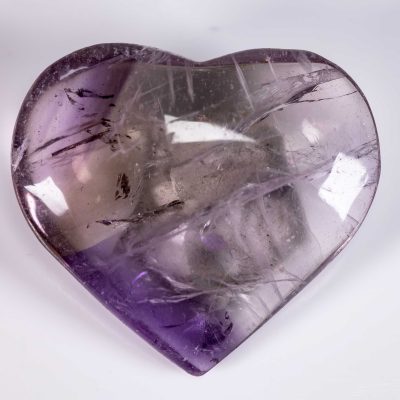
| Specimen Details | |
|---|---|
| Weight | 5.27 oz’s – 149.5 g |
| Dimensions | 2.833″ x 1.590″ long/wide (7.196 x 4.039 cm’s) |
| Country of Origin | Brazil |
Polished Rainbow Amethyst Point/Tower
USD $26.00
SKU: P5435
This specimen is Color Zoned Rainbow Amethyst, cut and polished into a Point/Tower. It has a Rich pop of color while also hiding some very tiny rainbows throughout. Amethyst is the corner stone of any crystal healing collection. A must have! This stone is a very worthwhile addition to anyone’s collection. It has a wide variety of uses and comes in handy shapes, forms and tools!
In stock
Use the tabs below to explore crystal origins, geological details, crystal care guidance, and metaphysical insights.
Click/Tap Buttons to Jump to Section
Rainbow Quartz Origins & Background
Rainbow Quartz refers to Quartz crystals that display internal spectral light effects—commonly referred to as rainbows—caused by light refracting through internal fractures, growth planes, or inclusions. These rainbows are natural optical phenomena and not surface treatments.
Rainbow effects can occur in many Quartz varieties including Clear Quartz, Smoky Quartz, Amethyst, and included forms. Each crystal expresses its rainbow uniquely, making every specimen distinct.
Rainbow Quartz has long been appreciated as a bridge between physical structure and light-based phenomena, symbolically representing the union of matter and spectrum.
Rainbow Quartz Geological Information
Rainbow effects in Quartz are produced when light passes through internal fractures or stress planes created during or after crystal growth. These micro-surfaces refract light into its component wavelengths, producing visible spectral colors.
The Quartz itself remains chemically unchanged; the rainbow effect is purely optical. These features often form under natural pressure changes, tectonic stress, or thermal fluctuations during the crystal’s geological history.
Physical Properties
| Property | Value |
|---|---|
| Mineral Species | Quartz (Rainbow variety) |
| Chemical Formula | SiO₂ |
| Crystal System | Trigonal |
| Hardness (Mohs Scale) | 7 |
| Luster | Vitreous |
| Transparency | Transparent to translucent |
| Defining Feature | Internal light spectrum (rainbows) |
Rainbow Expansion Effect
When rainbows occur within different Quartz varieties, they act as energetic expanders—broadening the crystal’s default properties across a wider range of expression.
Rainbow Quartz Crystal Care & Ownership Advice
⚠️ Handling:
Rainbow Quartz is durable but internal fractures can be sensitive to impact. Handle with care.
🧼 Cleaning:
Water-safe for brief rinsing. Avoid sudden temperature changes that may stress internal planes.
☀️ Light:
Light-stable. Rainbows are best viewed under directional light.
📦 Storage & Display:
Display where light can interact with the crystal. Rainbows often “activate” visually when the crystal is regularly handled or moved.
Click/Tap Buttons to Jump to Section
Amethyst Origins & Background
Amethyst has been valued across cultures for thousands of years for its rich violet coloration and its association with clarity, balance, and composure. The name Amethyst originates from the Greek word amethystos, meaning “not intoxicated,” reflecting an ancient belief that the stone helped maintain clear thinking and moderation.
Historically, Amethyst was considered a stone of royalty and spiritual authority. It adorned crowns, rings, and ceremonial objects in Ancient Greece and Rome and later throughout medieval Europe. Its purple color was rare and strongly associated with wisdom, restraint, and elevated status.
Significant Amethyst deposits are found in Brazil, Uruguay, Zambia, Madagascar, and Russia. Each locality produces crystals with distinctive growth habits, color zoning, and internal features, making provenance an important consideration for collectors and natural crystal enthusiasts.
Amethyst’s coloration develops through trace amounts of iron within the Quartz lattice combined with natural irradiation and geological heating over extended time periods. This process often creates layered growth zones that contribute to the depth and visual complexity seen in higher-quality specimens.
Some Amethyst crystals display structural growth features such as internal windows, phantoms, record keepers, and time-link faces. These are physical indicators of crystal formation traits and are valued for both the insight they provide into natural growth processes and to possible Metaphysical propoties.
Amethyst Geological Information
Amethyst is a violet variety of Quartz (Silicon Dioxide – SiO₂) that typically forms within cavities, veins, and geodes in igneous and metamorphic rock environments. Crystals usually grow as hexagonal prisms with pointed terminations.
The purple coloration results from trace iron incorporated into the Quartz structure combined with natural irradiation from surrounding rock. Subsequent geological heating stabilizes these color centers, producing hues that range from pale lavender to deep royal purple.
Amethyst commonly forms in volcanic environments, particularly within gas cavities of cooling basalt flows. Over millions of years, silica-rich fluids crystallize slowly, allowing layered growth and the development of internal zoning and structural features.
Common Geological Occurrences
- Volcanic basalt cavities and geodes
- Hydrothermal Quartz veins
- Metamorphic rock environments
Physical Properties
| Property | Value |
|---|---|
| Mineral Species | Quartz (Amethyst variety) |
| Chemical Formula | SiO₂ |
| Crystal System | Trigonal |
| Hardness (Mohs Scale) | 7 |
| Luster | Vitreous |
| Transparency | Transparent to translucent |
| Fracture | Conchoidal |
Amethyst Crystal Care & Ownership Advice
⚠️ Sunlight & Heat:
Prolonged exposure to intense sunlight or heat may cause some Amethyst specimens to fade over time. For long-term preservation, extended placement in direct sunlight is best avoided.
✋ Handling:
Amethyst is relatively durable, but sharp impacts can chip crystal points or edges. Handle specimens gently, especially clusters and terminated points.
🧼 Cleaning:
Clean Amethyst using lukewarm water and a soft brush. Avoid harsh chemicals, ultrasonic cleaners, or abrasive tools, which may damage crystal surfaces.
📦 Storage & Display:
Prolonged exposure to intense sunlight or high heat may cause some Amethyst specimens to fade over time.
For long-term preservation, extended placement in direct sunlight is best avoided. Indirect light or filtered natural light is ideal for display. This preserves color while still allowing the crystal’s natural beauty to be appreciated.
Flat Rate Shipping of only $6 – $9 USD equivalent, add as many items as you like!
- 30 days easy returns
- Faster shipping also available
 Guaranteed Safe Checkout
Related Crystal Specimens
-


-

-
USD $27.00
-
USD $69.00