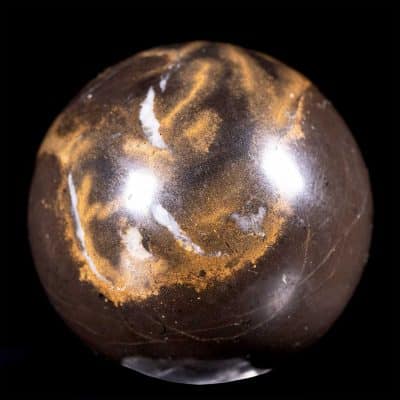
Warm honey-to-amber calcite coloration with natural translucency
Seated Buddha pose with hands in prayer gesture
Smooth polished finish highlighting natural stone texture
Detailed facial features and robe carving
Solid, free-standing carved stone figure
Exact piece shown – one of a kind
Specimen Details
Weight
34.85 oz (988.0 g)
Size
5.90 x 3.17 in (14.99 x 8.06 cm)
Material
Orange Calcite
Crystal Description
This hand-carved orange calcite Buddha sculpture features a serene seated posture with hands joined in a traditional prayer gesture. The warm amber and honey tones of the calcite give the figure a calming, organic presence while allowing subtle natural translucency to show through the stone. Read More →
Orange calcite is appreciated for its smooth texture and warm coloration, and this carving showcases those qualities beautifully. Natural tonal variation and soft internal clouding add depth and character without distracting from the carved form.
The Buddha’s facial features, robe folds, and hair texture are gently detailed, creating a balanced blend of refinement and natural stone character. Minor natural inclusions and surface variations are consistent with genuine calcite and confirm the authenticity of the material.
This piece stands solidly on its base and works well as a decorative object, meditation companion, or symbolic display. This listing is for the exact carving shown—an excellent addition for collectors of stone carvings, spiritual décor, or calcite art pieces.
Click/Tap Buttons to Jump to Section
Calcite Origins & Background
Calcite is one of the most abundant and widely distributed minerals on Earth and forms the structural foundation of many geological environments. It occurs in an extraordinary range of colors, crystal habits, and formations, making it one of the most diverse and fascinating mineral families available to collectors and crystal enthusiasts.
The name Calcite derives from the Latin word calx, meaning lime. Calcite has been used throughout human history for construction, sculpture, pigments, and tools — as well as for metaphysical and spiritual purposes in many ancient cultures.
Calcite occurs worldwide, with notable deposits found in Mexico, Iceland, Brazil, China, Madagascar, the United States, and across Europe. Different localities produce distinct crystal forms, colors, and optical properties.
Calcite is known for forming some of the most visually striking crystal habits, including scalenohedrons, rhombohedrons, dogtooth crystals, massive formations, stalactites, and fibrous aggregates. Many popular varieties — such as Blue Calcite, Orange Calcite, Honey Calcite, Green Calcite, and Caribbean Blue Calcite — all belong to the same mineral species.
Calcite is a calcium carbonate mineral (CaCO₃) and crystallizes in the trigonal crystal system. It forms through a wide variety of geological processes, including sedimentary deposition, hydrothermal activity, and biological accumulation.
Calcite is the primary component of limestone and marble and plays a critical role in Earth’s carbon cycle. It can precipitate directly from solution, form through metamorphism, or grow biologically in shells, coral, and skeletal structures.
One of Calcite’s most distinctive physical properties is its strong cleavage — it breaks cleanly in three directions — and its well-known optical double refraction, most famously demonstrated by Iceland Spar.
Common Geological Occurrences
Sedimentary limestone and marble
Hydrothermal veins
Caves, stalactites, and stalagmites
Association with Aragonite, Quartz, Fluorite, and other carbonates
⚠️ Handling: Calcite is relatively soft and easily scratched. Handle with care and avoid contact with harder minerals such as Quartz.
🧼 Cleaning: Avoid acids, vinegar, or harsh cleaners. Calcite can be gently wiped with a dry or slightly damp cloth. Prolonged water exposure is not recommended for polished pieces.
☀️ Light: Most Calcite varieties are stable in light, though some colored forms may fade with prolonged intense sunlight.
📦 Storage: Store Calcite separately or wrapped to prevent scratching and edge damage.
Calcite is widely regarded as a powerful energy amplifier and stabilizer. It helps energize the body’s electromagnetic systems while simultaneously promoting balance between opposing forces — particularly the Yin and Yang aspects of the self.
Calcite fortifies emotional strength and resilience, assisting in the release of fear, anxiety, and emotional stagnation. It is often worked with during periods of emotional recovery, mental recalibration, or when clarity and calm are required.
Because of its strong energetic conductivity, Calcite is frequently used to enhance awareness, perception, and the flow of subtle energy throughout the body. Many practitioners find it useful for clearing mental clutter and restoring energetic coherence.
Meditating with Calcite can help amplify thought processes, making it a popular stone for visualization, insight work, and astral or out-of-body exploration. Its energy is typically described as clarifying rather than overstimulating.
When used symbolically or energetically as an elixir (indirect methods recommended), Calcite is associated with detoxification and purification, with particular emphasis on supporting the kidneys and overall filtration processes within the body.
Calcite Crystal Pairings & Synergy
Calcite works exceptionally well with Clear Quartz to amplify clarity and intention, and with Fluorite to enhance mental organization and focus.
It also pairs beautifully with grounding stones such as Hematite and nurturing stones like… Rose Quartz, helping balance Calcite’s expansive qualities with emotional stability.
Summary
Calcite is a foundational crystal with broad applications across emotional, mental, and energetic work. Its ability to balance, clarify, and energize makes it a versatile and valuable companion for both beginners and experienced practitioners alike.



 Guaranteed Safe Checkout