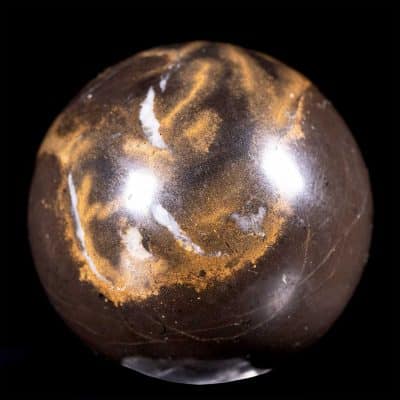
Weight – 7.81 oz’s – 222 gm’s
Dimensions – 4.707″ x 1.239″ long x wide (11.956 x 3.146 cm’s)
Country of Origin – Afghanistan



USD $36.00
SKU: P5687
This Lapis specimen has been carved and polished into a Point/Tower, which can be used as a massage tool!. This carving features Stunningly Rich color and showcases Unique patterns with a plethora of pyrite flakes included!!
In stock
Use the tabs below to explore crystal origins, geological details, crystal care guidance, and metaphysical insights.
Weight – 7.81 oz’s – 222 gm’s
Dimensions – 4.707″ x 1.239″ long x wide (11.956 x 3.146 cm’s)
Country of Origin – Afghanistan
Pyrite is a great mineral for treating physical burnout. It is recommended that a piece be placed on the solar plexus to achieve maximum energizing results. As Pyrite is largely iron and gold in color, it grounds the gold ray into the physical body. You may also point other higher vibrational crystals such as Citrine and Topaz towards/touching the Pyrite and it will ground those crystals’ gold ray energies into the physical body as well! Pyrite aids digestion, treats blood disorders and relieves depression. It has regenerative powers on physical and emotional levels.
This multi-talented mineral is a fantastic companion to have and carry around. It often comes on and inside other crystals such as Fluorite, Quartz, Lapis, and other high energy crystals!
Read more regarding Pyrite Properties at the link below (will open in a new tab/window)….
Click/Tap Buttons to Jump to Section
Lapis Lazuli is one of the most historically significant stones known to humankind, prized since antiquity for its deep blue color and symbolic association with truth, wisdom, and authority. It has been used for jewelry, carvings, sacred objects, and pigments for over 6,000 years.
Ancient civilizations including the Egyptians, Sumerians, Persians, and Greeks revered Lapis as a stone of royalty and spiritual insight. The famed ultramarine pigment used in Renaissance art was ground from high-quality Lapis Lazuli.
The finest traditional material comes from the legendary mines of Badakhshan, Afghanistan, which have been worked continuously since ancient times. Other sources include Chile, Russia, and Pakistan, though Afghan Lapis remains the benchmark for quality.
Lapis Lazuli is not a single mineral, but a rock composed primarily of lazurite, with varying amounts of calcite and pyrite. The deep blue color comes from lazurite, while pyrite appears as golden metallic flecks and calcite as white veining or patches.
Lapis forms in contact metamorphic environments, typically within limestone that has been altered by nearby igneous intrusions. The interlocking nature of its components gives Lapis both visual depth and energetic complexity.
| Property | Value |
|---|---|
| Rock Type | Metamorphic rock |
| Primary Mineral | Lazurite |
| Associated Minerals | Pyrite, Calcite |
| Hardness (Mohs Scale) | 5–5.5 |
| Luster | Dull to vitreous |
| Transparency | Opaque |
| Defining Feature | Deep blue with gold pyrite inclusions |
The naturally occurring pyrite within Lapis Lazuli is not a flaw—it is an essential component. Pyrite contributes grounding, stabilizing qualities and adds contrast that enhances both the visual and energetic balance of the stone.
⚠️ Handling:
Lapis Lazuli is softer than Quartz and should be handled with care to avoid scratches or chipping.
🧼 Cleaning:
Avoid water immersion. Clean gently with a dry or barely damp cloth. Do not soak or use chemicals.
☀️ Light:
Light-stable, but prolonged direct sunlight may dull surface polish over time.
📦 Storage & Display:
Store separately from harder stones. Polished pieces benefit from padded storage.
Flat Rate Shipping of only $6 – $9 USD equivalent, add as many items as you like!
 Guaranteed Safe Checkout