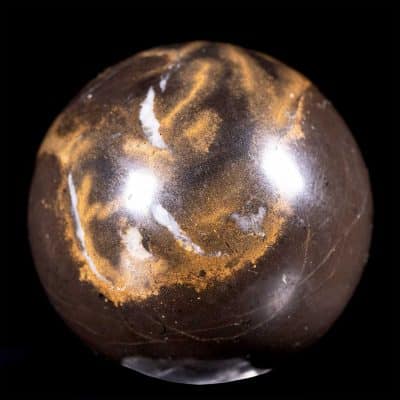
Tall polished flame silhouette with strong display presence
Large sparkling crystalized druzy face
Open keyhole-like window within the crystal pocket
Soft white agate with smoky grey outer edges
Visible banding and plume-like internal texture
Scattered dark mineral flecks across the druzy surface
Exact crystal shown that you will receive – one of a kind
Specimen Details
Weight
7.8 oz (222 g)
Size
5.6 x 3.7 x 0.5 in (14.3 x 9.3 x 1.2 cm)
Origin
Brazil
Crystal Description
You can see a polished crystalized banded agate flame from Brazil, shaped into a tall flame form with a broad sparkling druzy face and softly contrasting smoky grey agate edges.
Looking into the crystal, the front face opens into a large crystalized pocket filled with bright druzy points. The surface sparkles across the centre, with scattered dark mineral flecks adding contrast against the pale crystalline texture.
You can see an irregular keyhole-like window within the druzy area, giving the piece extra depth and a more sculptural display quality. Around the crystalized centre, pale agate banding and soft white layers frame the pocket, while the outer sides deepen into smoky grey translucent zones.
This crystal shows plume-like internal texture through the polished agate body, especially on the reverse side where the druzy pocket becomes more veiled beneath cloudy white agate. The darker side margins and smooth polished contours emphasize the tall flame outline and make the crystalized centre stand out clearly.
The combination of tall polished flame form, large crystalized druzy face, open internal window, visible banding, plume-like agate texture, and smoky grey edge contrast gives this Brazilian agate strong rarity, collectibility, and display value as a one-of-a-kind statement piece.
Click/Tap Buttons to Jump to Section
Agate Origins & Background
Agate is a banded variety of Chalcedony Quartz, valued for its wide range of colors, intricate patterns, and grounding visual presence. Unlike single-crystal Quartz, Agate forms in layered microcrystalline structures, giving rise to its distinctive banding and scenic patterns.
The name Agate is believed to originate from the Achates River (modern-day Dirillo River) in Sicily, where agates were collected in ancient times. Agate has been used for tools, seals, jewelry, and ornamental objects for thousands of years across many cultures.
Major Agate-producing regions include Brazil, Uruguay, India, Madagascar, Mexico, and the United States. Different localities produce distinct color palettes and banding styles, making provenance especially interesting for collectors.
Agates often display concentric banding, fortification patterns, or plume-like inclusions. These features are natural records of mineral-rich fluid deposition over long geological periods.
Historically, Agate has been associated with protection, balance, and stability. Many ancient cultures believed Agate offered grounding energy and physical protection during travel or battle.
Agate is a microcrystalline variety of Quartz (Silicon Dioxide – SiO₂), belonging to the Chalcedony group. It forms when silica-rich fluids fill cavities in volcanic or sedimentary rock and slowly crystallize in layers.
Over time, successive deposits of silica create Agate’s characteristic banding. Variations in trace minerals, temperature, and fluid chemistry influence color and pattern formation.
Agate commonly forms in volcanic environments, particularly within gas bubbles in basalt. As these cavities are gradually filled, layered growth develops from the outer edges inward.
⚠️ Sunlight & Heat:
Agate is generally stable in sunlight, but dyed Agates may fade with prolonged exposure. Natural Agate is best displayed in indirect or ambient light for long-term preservation.
✋ Handling:
Agate is durable, but sharp impacts can chip edges, especially on polished pieces. Handle with reasonable care.
🧼 Cleaning:
Agate is water-safe. Clean using lukewarm water and a soft brush or cloth. Avoid harsh chemicals that could affect surface polish or dye (if present).
📦 Storage & Display:
Store Agate away from harder or sharper stones that may scratch its surface. Polished Agates display well on padded stands or natural wood surfaces.
Agate is widely regarded as a stone of grounding, balance, and steady forward movement. Rather than working in sudden or intense ways, Agate supports gradual strengthening and preparation — making it especially useful during periods of change, long-term projects, or personal transitions.
This stone helps prepare one for change by providing steady, stabilizing energy. It is often worked with when beginning new projects or commitments, as it encourages persistence, follow-through, and practical momentum rather than impulsive action.
Agate is traditionally associated with strengthening the energetic body. It is said to stabilize the aura and assist in transforming negative or scattered energy into a more balanced, usable state. For this reason, many people find Agate helpful during times of emotional stress, fatigue, or when regaining footing after upheaval.
Agate has also been described as a stone of courage — not loud or forceful courage, but quiet inner resolve. In traditional practices, Agate elixirs were believed to enhance strength and resilience. The symbolic association remains an important part of Agate’s historical use.
Agate encourages clear, grounded thinking. It helps one focus on what is genuinely needed for overall well-being and is often used to support analysis and problem-solving. Many people work with Agate when facing complex situations, as it promotes breaking problems down into manageable parts rather than becoming overwhelmed.
Practical & Body-Based Uses
Agate is commonly used in hands-on applications such as massage and bodywork. Spheres, eggs, and wands are popular forms for this purpose, as the stone’s smooth surface and steady energy lend themselves well to calming, grounding physical contact.
Placed in a workspace or carried throughout the day, Agate can help maintain focus, emotional steadiness, and a sense of continuity — particularly when responsibilities feel layered or demanding.
Agate Crystal Pairings & Synergy
Agate pairs well with stones that support grounding, emotional balance, and steady energy flow.
It is often combined with Clear Quartz, Smoky Quartz,
and Rose Quartz.
Clear Quartz can amplify intention, Smoky Quartz deepens grounding and energetic stability, and Rose Quartz softens emotional processing when working with Agate’s stabilizing influence.
Agate also works well with non-Quartz stones such as Hematite (for grounding and focus), Black Tourmaline (for energetic protection and stability), and Green Aventurine (for gentle growth and well-being). These combinations are often chosen when steady progress and resilience are more important than rapid change.
Because Agate’s energy is subtle and supportive, it pairs best with stones that complement rather than overwhelm — making it a reliable foundation stone in multi-crystal work.
Important Notes on Color & Treatment
It is important to note that many brightly colored Agates — particularly deep blue and vivid pink varieties — are commonly dyed. Most orange Agate is heat-treated and sold as Carnelian. While natural Carnelian does exist, it is comparatively rarer and less commonly encountered.
These treatments do not diminish Agate’s structural beauty, but transparency around color enhancement helps collectors and enthusiasts make informed choices.
Agate Cleansing & Charging — Safe Methods First
⚠️ Important:
Energetic cleansing practices should never compromise the physical integrity of the stone. If a method risks etching, dulling, staining, or stressing the mineral, choose a gentler alternative.
Water safety: Most natural Agates are water-safe and can be gently rinsed using lukewarm water.
However, many Agates on the market — especially brightly colored varieties — may be dyed or heat-treated.
Avoid prolonged soaking, salt water, or harsh additives, as these can fade color or dull polish over time.
Recommended crystal-friendly cleansing options:
Smoke / smudging: incense, sage, palo santo (avoid heavy soot on polished surfaces).



 Guaranteed Safe Checkout