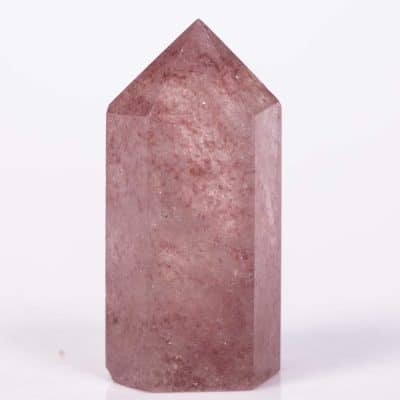
Warm orange orchid calcite with natural speckled patterning
Polished point with crisp facets and pointed termination
Solid, freestanding crystal suitable for display or meditation
Brazilian origin, cut and polished to emphasize internal texture
Specimen Details
Weight
10.93 oz (309.8 g)
Size
5.72 x 1.71 in (14.54 x 4.35 cm)
Origin
Brazil
Crystal Description
This polished orchid calcite point displays a rich orange tone with fine natural
mottling visible throughout the surface. The polish brings out the granular internal
structure while maintaining an organic, stone-like character. Read More →
Orchid calcite is a vibrant variety of calcite known for its uplifting color and
textured internal appearance. This piece features consistent coloration with
scattered darker mineral specks, giving it visual depth without distracting from
its clean, geometric form.
Shaped into a classic point, this crystal stands securely on its flat base and
works well as a focal display piece. Its size and weight make it suitable for
shelves, altars, or workspaces where a warm, energizing presence is desired.
Click/Tap Buttons to Jump to Section
Calcite Origins & Background
Calcite is one of the most abundant and widely distributed minerals on Earth and forms the structural foundation of many geological environments. It occurs in an extraordinary range of colors, crystal habits, and formations, making it one of the most diverse and fascinating mineral families available to collectors and crystal enthusiasts.
The name Calcite derives from the Latin word calx, meaning lime. Calcite has been used throughout human history for construction, sculpture, pigments, and tools — as well as for metaphysical and spiritual purposes in many ancient cultures.
Calcite occurs worldwide, with notable deposits found in Mexico, Iceland, Brazil, China, Madagascar, the United States, and across Europe. Different localities produce distinct crystal forms, colors, and optical properties.
Calcite is known for forming some of the most visually striking crystal habits, including scalenohedrons, rhombohedrons, dogtooth crystals, massive formations, stalactites, and fibrous aggregates. Many popular varieties — such as Blue Calcite, Orange Calcite, Honey Calcite, Green Calcite, and Caribbean Blue Calcite — all belong to the same mineral species.
Calcite is a calcium carbonate mineral (CaCO₃) and crystallizes in the trigonal crystal system. It forms through a wide variety of geological processes, including sedimentary deposition, hydrothermal activity, and biological accumulation.
Calcite is the primary component of limestone and marble and plays a critical role in Earth’s carbon cycle. It can precipitate directly from solution, form through metamorphism, or grow biologically in shells, coral, and skeletal structures.
One of Calcite’s most distinctive physical properties is its strong cleavage — it breaks cleanly in three directions — and its well-known optical double refraction, most famously demonstrated by Iceland Spar.
Common Geological Occurrences
Sedimentary limestone and marble
Hydrothermal veins
Caves, stalactites, and stalagmites
Association with Aragonite, Quartz, Fluorite, and other carbonates
⚠️ Handling: Calcite is relatively soft and easily scratched. Handle with care and avoid contact with harder minerals such as Quartz.
🧼 Cleaning: Avoid acids, vinegar, or harsh cleaners. Calcite can be gently wiped with a dry or slightly damp cloth. Prolonged water exposure is not recommended for polished pieces.
☀️ Light: Most Calcite varieties are stable in light, though some colored forms may fade with prolonged intense sunlight.
📦 Storage: Store Calcite separately or wrapped to prevent scratching and edge damage.
Calcite is widely regarded as a powerful energy amplifier and stabilizer. It helps energize the body’s electromagnetic systems while simultaneously promoting balance between opposing forces — particularly the Yin and Yang aspects of the self.
Calcite fortifies emotional strength and resilience, assisting in the release of fear, anxiety, and emotional stagnation. It is often worked with during periods of emotional recovery, mental recalibration, or when clarity and calm are required.
Because of its strong energetic conductivity, Calcite is frequently used to enhance awareness, perception, and the flow of subtle energy throughout the body. Many practitioners find it useful for clearing mental clutter and restoring energetic coherence.
Meditating with Calcite can help amplify thought processes, making it a popular stone for visualization, insight work, and astral or out-of-body exploration. Its energy is typically described as clarifying rather than overstimulating.
When used symbolically or energetically as an elixir (indirect methods recommended), Calcite is associated with detoxification and purification, with particular emphasis on supporting the kidneys and overall filtration processes within the body.
Calcite Crystal Pairings & Synergy
Calcite works exceptionally well with Clear Quartz to amplify clarity and intention, and with Fluorite to enhance mental organization and focus.
It also pairs beautifully with grounding stones such as Hematite and nurturing stones like… Rose Quartz, helping balance Calcite’s expansive qualities with emotional stability.
Summary
Calcite is a foundational crystal with broad applications across emotional, mental, and energetic work. Its ability to balance, clarify, and energize makes it a versatile and valuable companion for both beginners and experienced practitioners alike.
Green Tourmaline, also known as Verdelite, is a green-colored variety of Elbaite Tourmaline. It is one of the most widely distributed Tourmaline colors and is highly valued both as a mineral specimen and as a gemstone due to its clarity, durability, and vibrant coloration.
The green color is caused primarily by trace amounts of iron and, in some cases, chromium or vanadium introduced during crystal growth. These subtle chemical differences can produce shades ranging from pale mint green through to deep forest green.
Green Tourmaline forms most commonly in granitic pegmatites, where slow cooling allows elongated prismatic crystals to develop with strong vertical striations. Crystals may grow as single terminations, clusters, or embedded within Quartz matrices.
Notable sources of Green Tourmaline include Brazil, Afghanistan, Pakistan, Madagascar, Mozambique, Namibia, and parts of the United States. Each locality tends to produce material with distinctive growth habits and color saturation.
Tourmaline is naturally piezoelectric and pyroelectric, meaning it can generate an electrical charge when heated, cooled, or subjected to pressure—an unusual property that has fascinated scientists and mineralogists for centuries.
From a metaphysical perspective, Green Tourmaline is traditionally associated with vitality, heart energy, and physical regeneration.
Green Tourmaline is a complex borosilicate mineral belonging to the trigonal crystal system. Its chemical flexibility allows it to incorporate a wide range of elements, which is why Tourmaline occurs in more color variations than almost any other mineral group.
Crystals typically grow as long, vertically striated prisms with triangular cross-sections. Terminations can vary depending on growth conditions and may be sharp, flat, or complex.
Green Tourmaline is a powerful heart-centered crystal with a strong emphasis on physical vitality, regeneration, and energetic renewal. It works directly with the heart field, supporting both emotional balance and physical rejuvenation.
Physical Vitality & Regeneration
Traditionally, Green Tourmaline has been regarded as a potent stone for supporting the body during recovery and regeneration. It is often used to assist the body in addressing cellular stress and restoring energetic coherence at a deep level.
Electromagnetic System Support
Green Tourmaline is particularly effective at charging and clearing the electromagnetic system. Its natural electrical properties make it ideal for restoring energetic flow after exposure to stress, fatigue, or environmental interference.
Practical Ways to Work With Green Tourmaline
Overnight Recharging: Hold Green Tourmaline in the hands before sleep, place it under the pillow, or point a crystal toward the body from a bedside table to recharge the energetic system overnight.
Heart Vitality Meditation: Place the crystal over the heart and breathe steadily, visualizing green light revitalizing the body.
Elixir Work: Used as a carefully prepared indirect elixir, Green Tourmaline is traditionally associated with supporting detoxification and cellular balance.
Daily Energy Boost: Carry Green Tourmaline when feeling depleted to gently restore stamina and clarity.
Green Tourmaline Crystal Pairings & Synergy
Green Tourmaline pairs exceptionally well with Black Tourmaline for grounding and protection, Clear Quartz for amplification, Selenite for energetic clarity, and Rose Quartz to soften and harmonize heart energy.
Green Tourmaline Cleansing & Charging
⚠️ Important: Because Green Tourmaline is often used for intensive physical and energetic work, regular gentle cleansing is recommended.
Recommended methods:
Brief water rinse
Earth grounding
Moonlight
Sound cleansing
Selenite support
Summary
Green Tourmaline is a crystal of vitality, heart-centered regeneration, and energetic renewal. By supporting both physical systems and electromagnetic balance, it serves as a powerful ally for healing, recovery, and sustained personal energy.
Watermelon Tourmaline is one of the most visually distinctive and energetically harmonious members of the Tourmaline family. It is characterized by a green outer zone and a pink to red interior, closely resembling a slice of watermelon—hence its name.
This natural bi-color zoning occurs during crystal growth as changes in chemistry within the pegmatitic environment alter trace element availability. Rather than being a surface effect, the color separation is integral to the crystal’s internal structure.
Watermelon Tourmaline is prized not only for its beauty, but also because it naturally unites two powerful heart-centered color energies within a single crystal—making it a long-recognized master heart stone in crystal traditions.
Watermelon Tourmaline is a variety of Elbaite Tourmaline, a complex borosilicate mineral that forms in granitic pegmatites under conditions allowing slow, layered crystal growth.
The green exterior coloration is typically due to iron, while the pink to red core is caused by manganese. The distinct zoning forms as chemical conditions shift during crystal development, creating concentric layers rather than blended coloration.
Watermelon Tourmaline is regarded as a Master Heart Crystal, working simultaneously on the physical heart, emotional heart, and energetic heart center. The green outer layer represents healing, balance, and growth, while the pink core represents love, compassion, and emotional vitality.
Together, these colors create a naturally integrated heart frequency that is both nurturing and empowering.
Heart Healing & Emotional Integration
This crystal works deeply on emotional wounds, encouraging forgiveness, self-acceptance, and healthy emotional expression. Rather than forcing emotional release, Watermelon Tourmaline gently stabilizes the heart space so healing can occur naturally and safely.
It is particularly helpful for those who feel emotionally fragmented or pulled between opposing needs.
Balancing Masculine & Feminine Energies
Watermelon Tourmaline brings male and female aspects into harmony—whether within oneself or between partners. This balancing effect supports healthy relationships, cooperation, and emotional clarity without dominance or suppression.
Tourmaline Integration & Energy Synergy
One of this crystal’s unique gifts is its ability to harmonize and merge the energies of other Tourmaline varieties. It acts as a unifying agent, making Tourmaline energies more accessible and easier for the body, mind, and spirit to utilize together.
Creativity, Manifestation & Heart-Led Action
Watermelon Tourmaline not only inspires creative ideas—it helps gather the emotional and energetic resources needed to bring those ideas into physical reality. It encourages action that is aligned with the heart rather than driven by pressure or fear.
Practical Ways to Work With Watermelon Tourmaline
Heart Placement: Place the crystal directly over the heart during meditation to stabilize emotions and encourage gentle heart healing.
Relationship Work: Use during conversations or shared meditation to promote empathy, balance, and emotional honesty.
Creative Activation: Hold while visualizing creative ideas forming in the heart, then grounding them into actionable steps.
Tourmaline Synergy: Place Watermelon Tourmaline with other Tourmalines to harmonize and balance their combined energies.
Watermelon Tourmaline Cleansing & Charging
⚠️ Important: Because this crystal works deeply with emotional energy, regular gentle cleansing is recommended.
Recommended methods:
Short water rinse (dry thoroughly)
Resting on natural earth
Sound cleansing
Selenite plate or wand
Heart-centered intention reset
Summary
Watermelon Tourmaline is a masterful heart healer that unites love, balance, creativity, and manifestation. By harmonizing emotional, physical, and energetic heart frequencies, it supports heartfelt living, inspired creation, and meaningful connection—both within oneself and with others.
Pink Tourmaline is a color variety of the Tourmaline mineral group, specifically within the Elbaite species. Tourmaline itself is one of the most chemically complex mineral families known, capable of incorporating a wide range of elements during formation. This complexity is what allows Tourmaline to occur in such an extraordinary range of colors.
The pink coloration in Pink Tourmaline is primarily caused by trace amounts of manganese introduced during crystal growth. Variations in temperature, pressure, and chemistry can produce shades ranging from very pale pastel pink to deep rose and hot pink tones.
Pink Tourmaline most commonly forms in granitic pegmatites, where slow cooling allows crystals to grow large and well-defined. These environments often produce long prismatic crystals with vertical striations running along the length of the crystal.
Notable sources of Pink Tourmaline include Brazil, Afghanistan, Pakistan, Madagascar, Mozambique, and select regions of the United States (notably California and Maine). Each locality produces material with slightly different color saturation, crystal habit, and internal clarity.
Historically, Tourmaline was frequently misidentified as other gemstones. Pink Tourmaline was often confused with ruby or spinel until advances in mineralogy clarified its true identity in the 18th century.
From a metaphysical perspective, Pink Tourmaline is traditionally regarded as a heart-centered stone associated with compassion, emotional healing, and unconditional love.
Pink Tourmaline is a borosilicate mineral belonging to the trigonal crystal system. Its complex crystal chemistry allows for significant elemental substitution, which directly influences color and physical characteristics.
Crystals typically grow as elongated prisms with vertically striated faces. Terminations may be flat, pyramidal, or complex depending on growth conditions. Pink Tourmaline may occur as isolated crystals, clusters, or embedded within quartz matrices.
Pink Tourmaline is widely regarded as a master heart crystal, resonating strongly with unconditional love, emotional healing, and compassionate self-awareness. Its energy is gentle, nurturing, and steady rather than forceful.
Self-Love & Emotional Healing
This crystal supports the process of learning to love oneself fully. It encourages honest self-reflection, responsibility for past emotional patterns, and forgiveness without self-judgment.
Practical Ways to Work With Pink Tourmaline
Heart Meditation: Place over the heart and breathe slowly, visualizing soft pink light expanding with each breath.
Emotional Processing: Hold during journaling or reflection when working through forgiveness.
Sleep Support: Keep near the bed to promote calm, emotionally restorative sleep.
Daily Carry: Wear or carry close to the heart to maintain emotional balance throughout the day.
Pink Tourmaline Crystal Pairings & Synergy
Pink Tourmaline pairs exceptionally well with Selenite for gentle cleansing, Clear Quartz for amplification, Rose Quartz for emotional harmony, and Black Tourmaline to keep heart energy grounded and protected.
Pink Tourmaline Cleansing & Charging
⚠️ Important: Pink Tourmaline absorbs emotional energy and benefits from regular gentle clearing.
Recommended methods:
Brief water rinse
Moonlight
Sound cleansing
Selenite support
Heart-centered intention reset
Summary
Pink Tourmaline is a crystal of unconditional love, emotional responsibility, and gentle healing. It teaches that true strength comes from compassion—for oneself first, and then for others.
Tourmaline is one of the most chemically complex mineral families on Earth, comprising a large group of boron silicate minerals with varying compositions. This complexity is what allows Tourmaline to form in an extraordinary range of colors—often multiple colors within a single crystal.
The name “Tourmaline” originates from the Sinhalese word turmali, meaning “mixed gemstones,” a reference to the many differently colored crystals that were historically grouped together under this name.
Tourmaline occurs worldwide, with notable deposits in Brazil, Afghanistan, Pakistan, Africa, Madagascar, Sri Lanka, and the United States. Many of the finest multi-colored and gem-quality specimens come from Brazil and Afghanistan.
Tourmaline is strongly piezoelectric and pyroelectric, meaning it can generate an electrical charge when subjected to pressure or temperature change. This physical property has been studied extensively and contributes to Tourmaline’s use in scientific, industrial, and technological applications.
From a metaphysical perspective, Tourmaline has long been regarded as a stone of energetic regulation and balance across multiple levels.
Tourmaline forms primarily in granitic pegmatites, metamorphic rocks, and hydrothermal veins. Its complex chemistry allows it to incorporate a wide range of elements, including iron, magnesium, lithium, sodium, calcium, and aluminum.
Physical Properties
Property
Value
Mineral Class
Borosilicate
Chemical Formula
Complex (varies by species)
Crystal System
Trigonal
Hardness (Mohs)
7 – 7.5
Luster
Vitreous
Transparency
Transparent to opaque
Common Colors
Black, Green, Pink, Blue, Red, Yellow, Multicolor
Special Properties
Piezoelectric & Pyroelectric
Tourmaline crystals typically form as long prismatic columns with vertical striations. Zoned and bi-colored crystals are common due to changes in chemistry during growth.
🧼 Cleaning: Tourmaline may be gently cleaned with lukewarm water and a soft cloth. Avoid harsh chemicals and prolonged soaking, especially for lithium-rich varieties.
⚠️ Handling: Although relatively hard, Tourmaline can fracture along growth lines. Handle carefully, particularly long prismatic crystals.
☀️ Light Exposure: Some colored Tourmalines (especially pink and green) may fade with prolonged exposure to strong sunlight.
📦 Storage: Store separately to avoid scratching other crystals, particularly softer minerals.
Tourmalines charge and clear the electromagnetic system. They may be used as energetic “batteries” by holding them, placing them under the pillow, or positioning them nearby during rest to gently recharge the body.
Practical Ways to Work with Tourmaline
Electromagnetic Balancing Place Tourmaline near electronic devices or sleeping areas to assist in stabilizing energetic fluctuations and restoring equilibrium.
Back & Chakra Layouts Use Tourmaline crystals in a back layout aligned with chakra and color correspondences. This technique works on physical, emotional, and energetic levels simultaneously.
Color Therapy Tourmaline’s broad color range makes it ideal for color therapy. Select colors intuitively or align them with specific chakras to direct energy where it is needed most.
Elixir Work Tourmaline makes a powerful elixir. Combination elixirs using multiple Tourmaline colors are traditionally used to support respiratory balance, including asthma-related concerns.
Tourmaline Crystal Pairings & Synergy
Tourmaline works exceptionally well with Clear Quartz for amplification, Selenite for clarity and flow, and Black Tourmaline to ground and stabilize higher-frequency Tourmaline varieties.
Tourmaline Cleansing & Energetic Maintenance
Recommended methods:
Running water (brief)
Sound cleansing
Moonlight
Clear Quartz charging
Conscious intent
Avoid:
Harsh chemicals
Prolonged salt exposure
Summary
Tourmaline is one of the most versatile and adaptive crystal families available. With its unmatched color range, electrical properties, and balancing nature, it serves as both a stabilizer and an amplifier—making it an essential foundation crystal that supports and enhances all other varieties.
Blue Tourmaline, also known by its gemological name Indicolite, is one of the rarer and more sought-after color varieties within the Tourmaline family. Its coloration ranges from pale sky blue through to deep oceanic and inky blue tones.
The blue coloration is primarily caused by iron and, in some cases, trace amounts of copper within the crystal structure. Subtle variations in chemistry and growth conditions can produce dramatic differences in hue and saturation.
Blue Tourmaline forms in granitic pegmatites and is frequently found growing alongside other Tourmaline colors, most notably Green Tourmaline. Bi-colored and tri-colored crystals are not uncommon, reflecting shifts in mineral chemistry during crystal growth.
Notable sources of Blue Tourmaline include Brazil, Afghanistan, Pakistan, Madagascar, Mozambique, and parts of Africa. Fine-quality Indicolite is considerably rarer than Green or Pink Tourmaline and is highly prized by both collectors and lapidaries.
Tourmaline’s natural piezoelectric and pyroelectric properties—its ability to generate an electrical charge when heated, cooled, or compressed—are present in Blue Tourmaline as well, contributing to its distinctive physical and energetic characteristics.
From a metaphysical perspective, Blue Tourmaline is traditionally associated with calm communication, truth expression, and emotional clarity.
Blue Tourmaline is a borosilicate mineral belonging to the Elbaite subgroup of the Tourmaline family. It crystallizes in the trigonal crystal system and commonly forms elongated prismatic crystals with strong vertical striations.
Crystals may be singly terminated, doubly terminated, or occur in clusters. Color zoning is common, especially in specimens that transition between green, blue, and sometimes colorless sections.
Blue Tourmaline (Indicolite) carries a soothing, stabilizing energy that supports calm emotional expression, truthful communication, and deep inner stillness. Its influence is gentle yet penetrating, making it especially valuable during periods of stress or emotional overload.
Emotional Calm & Nervous System Support
Blue Tourmaline is traditionally used to calm emotions and soothe the nervous system. Its energy helps quiet mental noise, allowing thoughts to settle into a more coherent and peaceful state.
Truthful Communication
This crystal supports speaking one’s truth clearly and compassionately. It helps bridge the gap between inner knowing and outward expression, making it useful for difficult conversations or situations requiring honesty delivered with calm authority.
Deep Meditation & Blockage Release
Blue Tourmaline is an excellent meditation companion, particularly for entering deep, receptive states. It assists in releasing long-held emotional and energetic blockages that may surface gradually during meditative practice.
Sleep & Dream Work
Placed under the pillow, Blue Tourmaline promotes restful sleep and encourages insightful dreaming. Upon waking, it supports conscious dream recall and integration of dream messages into waking awareness.
Practical Ways to Work With Blue Tourmaline
Calming Elixir: Use as a carefully prepared indirect elixir to soothe emotions and nerves.
Truth Expression: Hold near the throat during reflection or communication work.
Meditation Aid: Meditate with the crystal to enter deeper states and release stored tension.
Dream Support: Place under the pillow to encourage meaningful, restorative dreams.
Blue Tourmaline Crystal Pairings & Synergy
Blue Tourmaline works exceptionally well alongside Green Tourmaline for heart–mind coherence, Black Tourmaline to ground and stabilize higher-frequency insight, Selenite for mental clarity, and Clear Quartz to amplify communication intent.
Blue Tourmaline Cleansing & Charging
⚠️ Important: Because Blue Tourmaline is often used for emotional and mental work, gentle and regular cleansing is recommended.
Recommended methods:
Brief water rinse
Moonlight
Sound cleansing
Selenite support
Earth grounding
Summary
Blue Tourmaline is a crystal of calm truth, emotional clarity, and deep inner stillness. By soothing the nervous system and supporting honest communication, it helps align thought, emotion, and expression into a coherent, peaceful whole.
Black Tourmaline, also known as Schorl, is the most common and widely distributed member of the Tourmaline family. Despite its abundance, it is considered one of the most functionally important Tourmalines due to its physical properties and exceptional stability.
Schorl forms in a wide range of geological environments, including granitic pegmatites, metamorphic rocks, and hydrothermal veins. It commonly appears as long, vertically striated prismatic crystals, sometimes forming clusters or radiating groups.
The black coloration of Schorl is caused primarily by high iron content. This iron-rich chemistry contributes to the mineral’s strong electrical and grounding characteristics, which have been studied extensively in both geological and industrial contexts.
Black Tourmaline has been used historically in electrical applications due to its natural piezoelectric and pyroelectric properties—meaning it can generate an electrical charge when subjected to pressure or temperature changes. These qualities make Tourmaline unique among silicate minerals.
Major sources of Black Tourmaline include Brazil, Pakistan, Afghanistan, Africa, Madagascar, the United States, and parts of Europe. Because it forms readily and abundantly, it remains one of the most accessible Tourmalines available today.
From a metaphysical perspective, Black Tourmaline is traditionally regarded as one of the most effective grounding and protective stones available.
Black Tourmaline is a complex borosilicate mineral belonging to the Tourmaline group, crystallizing in the trigonal crystal system. Its structure allows for significant elemental substitution, though Schorl is specifically iron-rich.
Crystals typically grow as elongated prisms with prominent vertical striations and triangular cross-sections. Terminations may be flat, complex, or broken, depending on growth conditions.
⚠️ Handling: Black Tourmaline is robust but can fracture along internal stress lines. Avoid dropping long prismatic crystals.
🧼 Cleaning: Water-safe for brief rinsing. Because it absorbs and grounds energy, regular cleansing is recommended.
☀️ Light: Light-stable and unaffected by sunlight.
📦 Storage & Display: Ideal for bedside tables, near electronic equipment, or as part of crystal layouts. Grounding on natural earth periodically helps reset the stone.
Black Tourmaline is one of the most reliable and versatile grounding crystals available. Rather than limiting expansion, it provides a stable energetic anchor that allows one to explore higher states safely—then return fully grounded and integrated.
Grounding & Integration
Black Tourmaline excels at grounding emotional energy, healing information, and insights gained during meditation or crystal layouts. It ensures that what is experienced energetically can be properly integrated into physical consciousness and daily life.
Shock, Stress & Emotional Reset
This crystal is especially useful during moments of shock, fright, or emotional overload. Holding Black Tourmaline helps the nervous system settle and restores a sense of safety and presence.
Sleep & Physical Restoration
Black Tourmaline is widely used to improve sleep quality. Placed under the pillow, held in the hand, or positioned near the lower body, it encourages deep, restorative sleep and helps the body recharge overnight.
Practical Ways to Work With Black Tourmaline
Healing Layout Anchor: Use Black Tourmaline in crystal layouts to ground and stabilize higher-frequency stones.
Allergy Relief: Hold in one hand for up to 10 minutes. If no change is felt, switch hands.
Sleep Support: Place under the pillow, in the hand, or near the groin region for deep, energizing sleep.
Daily Grounding: Carry when feeling scattered, overwhelmed, or energetically ungrounded.
Black Tourmaline Crystal Pairings & Synergy
Black Tourmaline pairs exceptionally well with higher-frequency crystals, acting as a stabilizing anchor.
⚠️ Important: Because Black Tourmaline absorbs and grounds energy continuously, frequent clearing is beneficial.
Recommended methods:
Brief water rinse
Direct earth placement
Sound cleansing
Selenite support
Summary
Black Tourmaline is the ultimate grounding crystal—versatile, reliable, and indispensable. It allows deep energetic exploration while ensuring safe return and full integration, earning its reputation as the true “Swiss Army knife” of the crystal healing world.



 Guaranteed Safe Checkout