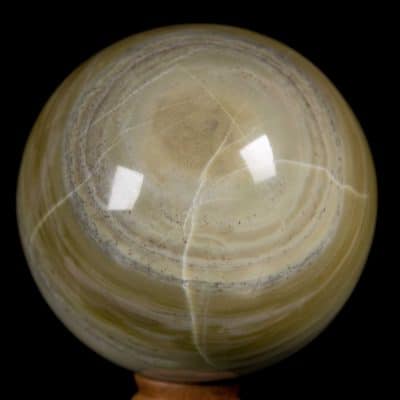
Weight – 70.1 gm’s
Dimensions – 5.8 x 4.2 cm’s wide/tall
Country of Origin – Colombia



USD $58.00
SKU: M1544
This Natural Colombianite has awesome texture/etchings and is translucent making it glow a gorgeous peachy tint when held to the light!! This specimen is in excellent condition!
In stock
Use the tabs below to explore crystal origins, geological details, crystal care guidance, and metaphysical insights.
Weight – 70.1 gm’s
Dimensions – 5.8 x 4.2 cm’s wide/tall
Country of Origin – Colombia
Click/Tap Buttons to Jump to Section
Tektites are natural glass objects formed by the extreme heat and pressure generated when large meteorites impact the Earth. The force of impact melts terrestrial material, ejecting it high into the atmosphere where it cools rapidly before falling back to Earth.
Tektites are found in distinct strewn fields around the world, including Australasia, Southeast Asia, Central Europe, and parts of Africa and North America. Their distribution helps scientists identify ancient impact events that may otherwise leave little visible trace.
Unlike volcanic glass, tektites contain very low water content and exhibit aerodynamic shapes such as teardrops, discs, and buttons, formed while molten material traveled through the atmosphere.
One metaphysical association traditionally attributed to tektites is their long-standing link with transformation and cosmic perspective, owing to their extraterrestrial impact origins.
Tektites are amorphous natural glass rather than crystalline minerals. Their composition reflects the terrestrial material at the impact site, fused and homogenized by intense heat.
| Property | Value |
|---|---|
| Material Type | Natural Impact Glass |
| Crystal System | Amorphous |
| Hardness (Mohs) | 5 – 6 |
| Color | Black, brown, olive green |
| Luster | Glassy to dull |
| Water Content | Extremely low |
🧼 Cleaning:
Clean gently with a dry or slightly damp cloth. Avoid prolonged soaking, especially for etched or pitted specimens.
📦 Storage:
Store separately from harder minerals to prevent scratching. Many tektites have naturally fragile surfaces.
☀️ Environment:
Tektites are stable under normal conditions and do not require special light or humidity control.
⚠️ Handling:
Edges can be sharp on some specimens. Handle with care.
Click/Tap Buttons to Jump to Section
Colombianite is a naturally occurring glassy material found primarily in Colombia, most commonly in alluvial deposits and river systems. While often appearing opaque at first glance, high-quality Colombianite—such as the specimens offered here—can be translucent throughout the entire body when backlit, revealing internal light transmission uncommon in most obsidian-type glasses.
Colombianite has attracted significant attention due to its strong metaphysical reputation and its debated geological origin. While sometimes described in metaphysical circles as a tektite or impact-related material, Colombianite is best understood geologically as a natural volcanic glass closely related to obsidian. Current geological evidence supports terrestrial volcanic formation rather than confirmed extraterrestrial impact origin.
Despite this, its formation environment, chemical composition, and visual characteristics differ subtly from many common obsidians, contributing to its distinct identity and long-standing local reverence.
Colombianite has been used and respected by indigenous cultures in Colombia long before modern naming conventions emerged. Its association with rivers and ancient landscapes has contributed to its symbolic connection with ancestry, memory, and transmission of knowledge.
Colombianite is a silica-rich volcanic glass formed when molten material cools rapidly, preventing the development of a crystalline structure. As a result, it is amorphous rather than crystalline and lacks a defined crystal system.
Geochemically, Colombianite is similar to obsidian but may show compositional variations related to its volcanic source material and cooling history. It is often found as water-worn pebbles or nodules due to prolonged transport in river systems.
Because it is glassy, Colombianite exhibits conchoidal fracture and sharp edges when broken. Its surface may appear matte, satin-like, or glossy depending on weathering and polish.
| Property | Value |
|---|---|
| Material Type | Natural volcanic glass (Obsidian-type) |
| Chemical Composition | Silica-rich glass |
| Crystal System | Amorphous (non-crystalline) |
| Hardness (Mohs Scale) | 5 – 5.5 |
| Luster | Vitreous to satin |
| Transparency | Opaque to translucent edges |
| Fracture | Conchoidal |
| Typical Occurrence | River deposits and volcanic regions (Colombia) |
⚠️ Handling:
Although fairly durable, Colombianite can develop sharp edges if chipped. Handle mindfully and avoid impacts.
🧼 Cleaning:
Water-safe for brief rinsing. Avoid temperature extremes and ultrasonic cleaners. Dry thoroughly.
☀️ Light:
Light-stable and suitable for normal display conditions.
📦 Storage & Display:
Store separately or padded to prevent edge damage. Polished pieces benefit from cushioned storage.
Click/Tap Buttons to Jump to Section
Colombianite is a naturally occurring glassy material found primarily in Colombia, most commonly in alluvial deposits and river systems. It is visually dark—typically black, deep brown, or smoky gray—and may show translucency at thin edges when held to the light.
Colombianite has attracted significant attention due to its strong metaphysical reputation and its debated geological origin. While sometimes described in metaphysical circles as a tektite or impact-related material, Colombianite is best understood geologically as a natural volcanic glass closely related to obsidian. Current geological evidence supports terrestrial volcanic formation rather than confirmed extraterrestrial impact origin.
Despite this, its formation environment, chemical composition, and visual characteristics differ subtly from many common obsidians, contributing to its distinct identity and long-standing local reverence.
Colombianite has been used and respected by indigenous cultures in Colombia long before modern naming conventions emerged. Its association with rivers and ancient landscapes has contributed to its symbolic connection with ancestry, memory, and transmission of knowledge.
Colombianite is a silica-rich volcanic glass formed when molten material cools rapidly, preventing the development of a crystalline structure. As a result, it is amorphous rather than crystalline and lacks a defined crystal system.
Geochemically, Colombianite is similar to obsidian but may show compositional variations related to its volcanic source material and cooling history. It is often found as water-worn pebbles or nodules due to prolonged transport in river systems.
Because it is glassy, Colombianite exhibits conchoidal fracture and sharp edges when broken. Its surface may appear matte, satin-like, or glossy depending on weathering and polish.
| Property | Value |
|---|---|
| Material Type | Natural volcanic glass (Obsidian-type) |
| Chemical Composition | Silica-rich glass |
| Crystal System | Amorphous (non-crystalline) |
| Hardness (Mohs Scale) | 5 – 5.5 |
| Luster | Vitreous to satin |
| Transparency | Opaque to translucent edges |
| Fracture | Conchoidal |
| Typical Occurrence | River deposits and volcanic regions (Colombia) |
⚠️ Handling:
Although fairly durable, Colombianite can develop sharp edges if chipped. Handle mindfully and avoid impacts.
🧼 Cleaning:
Water-safe for brief rinsing. Avoid temperature extremes and ultrasonic cleaners. Dry thoroughly.
☀️ Light:
Light-stable and suitable for normal display conditions.
📦 Storage & Display:
Store separately or padded to prevent edge damage. Polished pieces benefit from cushioned storage.
Click/Tap Buttons to Jump to Section
Moldavite is a rare type of tektite formed approximately 14.7–15 million years ago following a massive meteorite impact in what is now southern Germany. This event created the Nördlinger Ries crater, one of the most studied impact structures on Earth.
The intense heat and pressure from the impact melted terrestrial rock, ejecting it high into the atmosphere. As the molten material cooled during flight, it formed aerodynamic glassy bodies that later fell across Central Europe.
Moldavite is found primarily in the Czech Republic, with additional deposits in Germany and Austria. Its distribution forms a well-defined strewn field that has helped geologists confirm its impact origin.
Characteristic surface textures such as grooves, wrinkles, and etching formed as the molten glass interacted with atmospheric forces and groundwater chemistry after deposition.
One metaphysical association often attributed to Moldavite is its long-standing reputation as a catalyst for rapid change, likely influenced by its dramatic cosmic origin and rarity.
Moldavite is an amorphous natural glass rather than a crystalline mineral. It belongs to the tektite family and reflects the chemistry of terrestrial rocks at the impact site rather than extraterrestrial material itself.
| Property | Value |
|---|---|
| Material Type | Natural Impact Glass (Tektite) |
| Crystal System | Amorphous |
| Hardness (Mohs) | ~5.5 |
| Color | Light to dark green |
| Luster | Vitreous (glassy) |
| Density | 2.32 – 2.38 g/cm³ |
| Primary Composition | Silica (SiO₂) with metal oxides |
🧼 Cleaning:
Clean gently using a dry or lightly damp cloth. Avoid ultrasonic cleaners and prolonged soaking.
📦 Storage:
Store separately from harder minerals to prevent scratching. Moldavite surfaces are often naturally etched and delicate.
⚠️ Handling:
Moldavite is relatively brittle compared to crystalline quartz. Handle with care, especially thin or sculpted pieces.
🌡️ Environment:
Stable under normal conditions. Avoid sudden temperature changes.
Flat Rate Shipping of only $6 – $9 USD equivalent, add as many items as you like!
 Guaranteed Safe Checkout