| Specimen Details | |
|---|---|
| Weight | 1.53 oz’s – 43.3 g |
| Dimensions | 1.38″ x 2.36″ tall/wide (3.5 x 6 cm’s) |
| Country of Origin | Vera Cruz, Mexico |
High Grade Vera Cruz Amethyst Quartz Crystal Cluster
USD $75.00
SKU: A1096
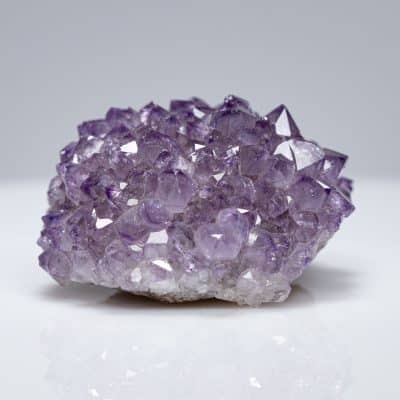
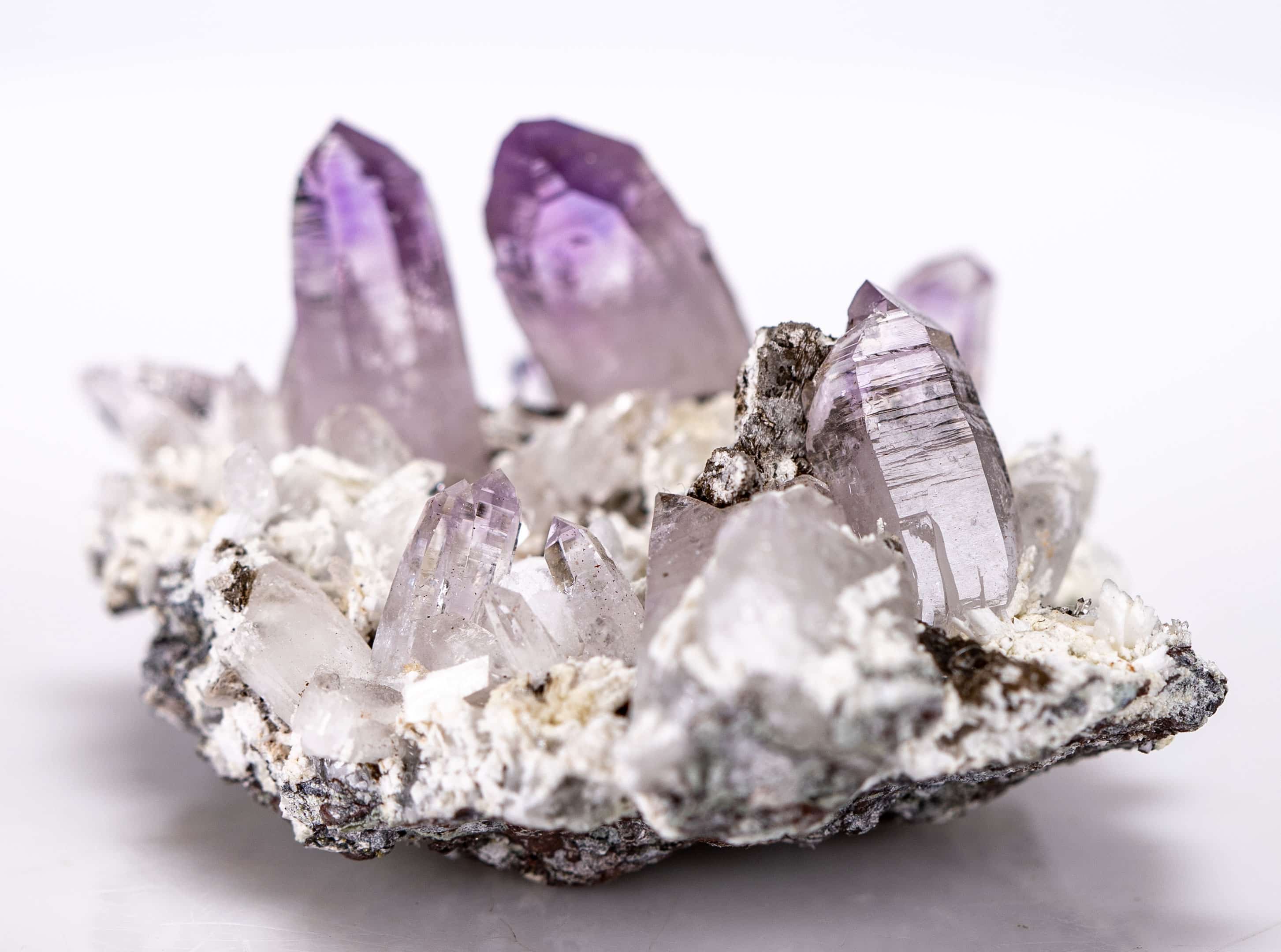
This Amethyst Crystal Cluster from Vera Cruz Mexico features gorgeous lavender color with awesome form sporting striking striations and shining luster!! Checkout the video just above for a wraparound view of this fantastic Amethyst cluster! This specimen is in excellent condition.
In stock
Use the tabs below to explore crystal origins, geological details, crystal care guidance, and metaphysical insights.
Click/Tap Buttons to Jump to Section
Vera Cruz Amethyst Origins & Background
Vera Cruz Amethyst is a distinctive variety of Amethyst sourced exclusively from the Vera Cruz region of Mexico. It is renowned for its exceptionally slender, elongated crystal habit, high clarity, and refined lavender-to-light-violet coloration.
Unlike many Amethyst varieties that form as robust points or clusters, Vera Cruz Amethyst typically grows as thin, laser-like crystals, often in delicate sprays or singular wand-like formations. These crystals are naturally terminated and rarely require cutting or shaping.
Vera Cruz Amethyst gained recognition relatively recently compared to classic Amethyst localities, but has quickly become highly sought after by collectors, energy practitioners, and mineral enthusiasts due to its purity, form, and energetic reputation.
The region’s geological conditions allow for unusually clean crystal growth, with minimal inclusions and a distinctive glassy luster. This contributes to the refined appearance and precision-focused character for which Vera Cruz Amethyst is known.
Because of their fragility and unique growth habit, intact Vera Cruz Amethyst specimens are increasingly uncommon, and careful handling is essential to preserve their natural form.
Vera Cruz Amethyst Geological Information
Vera Cruz Amethyst is a violet variety of Quartz (Silicon Dioxide – SiO₂), forming under hydrothermal conditions within volcanic host rock. It shares the same fundamental chemistry as all Amethyst, but differs significantly in crystal habit and formation style.
Crystals grow slowly from silica-rich fluids, allowing elongated, narrow prisms to develop with sharp natural terminations. The pale coloration reflects lower iron concentrations compared to darker Amethyst varieties, combined with stable irradiation conditions.
Vera Cruz Amethyst commonly forms in association with fine Quartz druze and delicate crystalline matrices. The resulting crystals are often free-standing and lightly attached, contributing to their airy, fragile appearance.
Common Geological Occurrences
- Hydrothermal Quartz veins
- Volcanic rock cavities
- Fine crystalline matrices and druze
Physical Properties
| Property | Value |
|---|---|
| Mineral Species | Quartz (Vera Cruz Amethyst variety) |
| Chemical Formula | SiO₂ |
| Crystal System | Trigonal |
| Hardness (Mohs Scale) | 7 |
| Luster | Vitreous |
| Transparency | Transparent to translucent |
| Fracture | Conchoidal |
Vera Cruz Amethyst Crystal Care & Ownership Advice
⚠️ Fragility:
Vera Cruz Amethyst is structurally delicate. The slender crystal points can snap or chip easily if dropped or knocked. Handle with particular care.
☀️ Sunlight & Heat:
As with most Amethyst, prolonged exposure to strong sunlight or heat may cause gradual fading. Display in indirect or filtered light.
🧼 Cleaning:
Clean gently using lukewarm water and a very soft brush. Avoid ultrasonic cleaners or abrasive tools.
📦 Storage & Display:
Display on padded surfaces or within protective cases. Avoid stacking with heavier or harder minerals.
Vera Cruz Mining Region Photos


Click/Tap Buttons to Jump to Section
Amethyst Clusters Origins & Background
Amethyst Clusters are among the most recognized and widely collected forms of Amethyst. Rather than growing as single points, clusters consist of multiple crystal points sharing a common base, creating a radiating crystalline surface.
The appearance of Amethyst clusters varies significantly depending on geological conditions, growth environment, and locality. Factors such as available space, mineral concentration, temperature stability, and fluid movement all influence point size, density, color zoning, and overall structure.
Some clusters form as dense carpets of small points, while others develop fewer but larger, well-terminated crystals. Color can range from pale lavender to deep violet, sometimes with zoning, phantoms, or smoky undertones.
Major sources of Amethyst clusters include Brazil, Uruguay, Zambia, Madagascar, and Russia. Each region is known for distinct characteristics — for example, Uruguay is often associated with deeper color saturation, while Brazil commonly produces larger clusters with lighter hues.
Because clusters form in open cavities, their growth is influenced by the shape and size of the host rock, resulting in highly individual specimens with natural variation and character.
Amethyst Clusters Geological Information
Amethyst clusters form when silica-rich fluids enter open cavities within volcanic or metamorphic rock and crystallize over long periods. Multiple crystal points nucleate simultaneously on the cavity walls, growing inward toward the center.
The trigonal crystal structure of Quartz causes crystals to grow as six-sided prisms with pointed terminations. When conditions allow many growth sites to remain active at once, clusters develop rather than isolated points.
Variations in fluid chemistry, temperature, and mineral availability can cause differences in point size, clarity, and coloration within a single cluster. Growth interruptions may result in features such as phantoms, growth lines, or uneven point heights.
The characteristic purple color of Amethyst results from trace iron within the Quartz lattice combined with natural irradiation and subsequent geological heating.
Common Geological Occurrences
- Volcanic basalt cavities and geodes
- Hydrothermal Quartz veins
- Metamorphic rock environments
Physical Properties
| Property | Value |
|---|---|
| Mineral Species | Quartz (Amethyst variety) |
| Chemical Formula | SiO₂ |
| Crystal System | Trigonal |
| Hardness (Mohs Scale) | 7 |
| Luster | Vitreous |
| Transparency | Transparent to translucent |
| Fracture | Conchoidal |
Amethyst Clusters Crystal Care & Ownership Advice
⚠️ Sunlight & Heat:
Prolonged exposure to strong sunlight or heat may cause some Amethyst clusters to fade over time. Indirect or filtered light is recommended for display.
✋ Handling:
While Quartz is relatively hard, cluster points can chip if struck. Lift clusters from the base rather than by individual points.
🧼 Cleaning:
Clean using lukewarm water and a soft brush to remove dust between points. Avoid harsh chemicals or ultrasonic cleaners.
📦 Storage & Display:
Place clusters on stable surfaces where they are unlikely to be bumped. Padding beneath the base can help prevent accidental movement.
Click/Tap Buttons to Jump to Section
Amethyst Origins & Background
Amethyst has been valued across cultures for thousands of years for its rich violet coloration and its association with clarity, balance, and composure. The name Amethyst originates from the Greek word amethystos, meaning “not intoxicated,” reflecting an ancient belief that the stone helped maintain clear thinking and moderation.
Historically, Amethyst was considered a stone of royalty and spiritual authority. It adorned crowns, rings, and ceremonial objects in Ancient Greece and Rome and later throughout medieval Europe. Its purple color was rare and strongly associated with wisdom, restraint, and elevated status.
Significant Amethyst deposits are found in Brazil, Uruguay, Zambia, Madagascar, and Russia. Each locality produces crystals with distinctive growth habits, color zoning, and internal features, making provenance an important consideration for collectors and natural crystal enthusiasts.
Amethyst’s coloration develops through trace amounts of iron within the Quartz lattice combined with natural irradiation and geological heating over extended time periods. This process often creates layered growth zones that contribute to the depth and visual complexity seen in higher-quality specimens.
Some Amethyst crystals display structural growth features such as internal windows, phantoms, record keepers, and time-link faces. These are physical indicators of crystal formation traits and are valued for both the insight they provide into natural growth processes and to possible Metaphysical propoties.
Amethyst Geological Information
Amethyst is a violet variety of Quartz (Silicon Dioxide – SiO₂) that typically forms within cavities, veins, and geodes in igneous and metamorphic rock environments. Crystals usually grow as hexagonal prisms with pointed terminations.
The purple coloration results from trace iron incorporated into the Quartz structure combined with natural irradiation from surrounding rock. Subsequent geological heating stabilizes these color centers, producing hues that range from pale lavender to deep royal purple.
Amethyst commonly forms in volcanic environments, particularly within gas cavities of cooling basalt flows. Over millions of years, silica-rich fluids crystallize slowly, allowing layered growth and the development of internal zoning and structural features.
Common Geological Occurrences
- Volcanic basalt cavities and geodes
- Hydrothermal Quartz veins
- Metamorphic rock environments
Physical Properties
| Property | Value |
|---|---|
| Mineral Species | Quartz (Amethyst variety) |
| Chemical Formula | SiO₂ |
| Crystal System | Trigonal |
| Hardness (Mohs Scale) | 7 |
| Luster | Vitreous |
| Transparency | Transparent to translucent |
| Fracture | Conchoidal |
Amethyst Crystal Care & Ownership Advice
⚠️ Sunlight & Heat:
Prolonged exposure to intense sunlight or heat may cause some Amethyst specimens to fade over time. For long-term preservation, extended placement in direct sunlight is best avoided.
✋ Handling:
Amethyst is relatively durable, but sharp impacts can chip crystal points or edges. Handle specimens gently, especially clusters and terminated points.
🧼 Cleaning:
Clean Amethyst using lukewarm water and a soft brush. Avoid harsh chemicals, ultrasonic cleaners, or abrasive tools, which may damage crystal surfaces.
📦 Storage & Display:
Prolonged exposure to intense sunlight or high heat may cause some Amethyst specimens to fade over time.
For long-term preservation, extended placement in direct sunlight is best avoided. Indirect light or filtered natural light is ideal for display. This preserves color while still allowing the crystal’s natural beauty to be appreciated.
Flat Rate Shipping of only $6 – $9 USD equivalent, add as many items as you like!
- 30 days easy returns
- Faster shipping also available
 Guaranteed Safe Checkout
Related Crystal Specimens
-
 USD $29.00
 -
USD $29.00
-
USD $69.00
-
USD $38.00