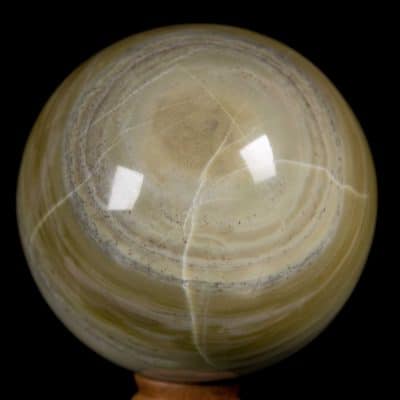
High grade Caribbean Blue Calcite with vivid ocean-blue tones
Natural banding with wave-like calcite layering
Organic cavities and pockets formed during crystal growth
Precisely polished obelisk with a clean, symmetrical point
Striking contrast between blue calcite and earthy matrix bands
Specimen Details
Weight
9.45 oz (267.8 g)
Size
4.15 x 1.60 in (10.544 x 4.063 cm)
Origin
Pakistan
Crystal Description
This high grade Caribbean Blue Calcite obelisk features tranquil blue coloration layered with flowing, wave-like banding that gives the stone a distinctly oceanic appearance. Naturally occurring cavities and openings add depth and character, highlighting the mineral’s organic formation. Read More →
The polished obelisk shape enhances the natural movement within the calcite, allowing the layered bands to flow upward toward a cleanly finished point. Subtle brown and cream matrix lines provide contrast against the soothing blue calcite, creating a visually dynamic yet calming piece.
Caribbean Blue Calcite is prized for its serene color palette and grounding presence. This specimen’s combination of polish and natural cavities makes it especially appealing for collectors who appreciate both refined craftsmanship and untouched geological features.
Click/Tap Buttons to Jump to Section
Aragonite Origins & Background
Aragonite is a calcium carbonate mineral closely related to Calcite. Although the two share the same chemical formula, they differ in crystal structure, giving Aragonite its distinct growth habits and physical properties.
Aragonite is best known for forming striking crystal clusters, including starburst, spray, and branching formations. These structures reflect rapid crystallization under specific environmental conditions.
In addition to crystalline forms, Aragonite commonly occurs in massive form. This material is often compact, banded, or intergrown with other calcium-based minerals, making it suitable for cutting and polishing.
Aragonite is found worldwide, with notable deposits in Spain, Morocco, Peru, Mexico, Namibia, Pakistan and the United States.
Some well-known lapidary materials sold under trade names — such as Caribbean Blue Calcite — are actually natural combinations of Aragonite and Calcite. These mixed compositions reflect geological transitions rather than artificial assembly.
Aragonite is a polymorph of calcium carbonate (CaCO₃), meaning it shares its chemical composition with Calcite but crystallizes in a different structure.
It forms primarily in low-temperature environments, including sedimentary deposits, hydrothermal systems, caves, and marine settings. Aragonite is also a major component of shells, corals, and some reef structures.
Crystalline Aragonite typically forms as orthorhombic prisms, needles, or radiating clusters. These forms often result from rapid mineral precipitation under conditions of high saturation.
Massive Aragonite forms when crystals grow too densely to develop distinct faces. This material often occurs alongside Calcite, forming layered or blended structures that are visually striking when polished.
Aragonite is widely regarded as a grounding and stabilizing stone, particularly helpful during times of stress, emotional overload, or rapid change. Its energy is often described as steady, centering, and supportive rather than stimulating.
Crystalline Aragonite, especially in radiating or starburst formations, is often associated with bringing order to chaotic situations. These forms are frequently used when one feels scattered or overwhelmed, helping to re-establish a sense of structure and balance.
Massive Aragonite has a gentler, more diffused energy. It is commonly worked with for emotional grounding, patience, and steady progress, making it suitable for long-term personal growth rather than rapid transformation.
Because Aragonite forms in both terrestrial and marine environments, it is often associated with balancing emotional and physical states, helping one feel supported while remaining adaptable.
Practical & Everyday Uses
Aragonite is well suited for grounding practices, meditation focused on stability, and environments where calm reassurance is desired. Many people place it in living or working spaces to help maintain emotional equilibrium.
Aragonite Crystal Pairings & Synergy
Aragonite pairs well with stones that support grounding and gentle clarity.
It is often combined with Smoky Quartz for grounding, Calcite for emotional flow, and Hematite for stability and focus.
Aragonite Cleansing & Charging — Safe Methods First
⚠️ Important: Aragonite is sensitive to water and acids.
Water safety: Not recommended for soaking. Brief surface contact only, if at all.
Recommended crystal-safe methods:
Sound: singing bowls, bells.
Moonlight: gentle overnight exposure.
Intention / meditation: visualization or breathwork.
Selenite plate: dry cleansing option.
If unsure: choose dry, non-contact cleansing methods.
Calcite is one of the most abundant and widely distributed minerals on Earth and forms the structural foundation of many geological environments. It occurs in an extraordinary range of colors, crystal habits, and formations, making it one of the most diverse and fascinating mineral families available to collectors and crystal enthusiasts.
The name Calcite derives from the Latin word calx, meaning lime. Calcite has been used throughout human history for construction, sculpture, pigments, and tools — as well as for metaphysical and spiritual purposes in many ancient cultures.
Calcite occurs worldwide, with notable deposits found in Mexico, Iceland, Brazil, China, Madagascar, the United States, and across Europe. Different localities produce distinct crystal forms, colors, and optical properties.
Calcite is known for forming some of the most visually striking crystal habits, including scalenohedrons, rhombohedrons, dogtooth crystals, massive formations, stalactites, and fibrous aggregates. Many popular varieties — such as Blue Calcite, Orange Calcite, Honey Calcite, Green Calcite, and Caribbean Blue Calcite — all belong to the same mineral species.
Calcite is a calcium carbonate mineral (CaCO₃) and crystallizes in the trigonal crystal system. It forms through a wide variety of geological processes, including sedimentary deposition, hydrothermal activity, and biological accumulation.
Calcite is the primary component of limestone and marble and plays a critical role in Earth’s carbon cycle. It can precipitate directly from solution, form through metamorphism, or grow biologically in shells, coral, and skeletal structures.
One of Calcite’s most distinctive physical properties is its strong cleavage — it breaks cleanly in three directions — and its well-known optical double refraction, most famously demonstrated by Iceland Spar.
Common Geological Occurrences
Sedimentary limestone and marble
Hydrothermal veins
Caves, stalactites, and stalagmites
Association with Aragonite, Quartz, Fluorite, and other carbonates
⚠️ Handling: Calcite is relatively soft and easily scratched. Handle with care and avoid contact with harder minerals such as Quartz.
🧼 Cleaning: Avoid acids, vinegar, or harsh cleaners. Calcite can be gently wiped with a dry or slightly damp cloth. Prolonged water exposure is not recommended for polished pieces.
☀️ Light: Most Calcite varieties are stable in light, though some colored forms may fade with prolonged intense sunlight.
📦 Storage: Store Calcite separately or wrapped to prevent scratching and edge damage.
Calcite is widely regarded as a powerful energy amplifier and stabilizer. It helps energize the body’s electromagnetic systems while simultaneously promoting balance between opposing forces — particularly the Yin and Yang aspects of the self.
Calcite fortifies emotional strength and resilience, assisting in the release of fear, anxiety, and emotional stagnation. It is often worked with during periods of emotional recovery, mental recalibration, or when clarity and calm are required.
Because of its strong energetic conductivity, Calcite is frequently used to enhance awareness, perception, and the flow of subtle energy throughout the body. Many practitioners find it useful for clearing mental clutter and restoring energetic coherence.
Meditating with Calcite can help amplify thought processes, making it a popular stone for visualization, insight work, and astral or out-of-body exploration. Its energy is typically described as clarifying rather than overstimulating.
When used symbolically or energetically as an elixir (indirect methods recommended), Calcite is associated with detoxification and purification, with particular emphasis on supporting the kidneys and overall filtration processes within the body.
Calcite Crystal Pairings & Synergy
Calcite works exceptionally well with Clear Quartz to amplify clarity and intention, and with Fluorite to enhance mental organization and focus.
It also pairs beautifully with grounding stones such as Hematite and nurturing stones like… Rose Quartz, helping balance Calcite’s expansive qualities with emotional stability.
Summary
Calcite is a foundational crystal with broad applications across emotional, mental, and energetic work. Its ability to balance, clarify, and energize makes it a versatile and valuable companion for both beginners and experienced practitioners alike.



 Guaranteed Safe Checkout