Weight
13.5 oz’s x 385 gm’s
Dimensions
(Without Base) 6.5 x 1.7″ long and wide 16.7 x 4.4 cm’s
Country
Brazil





USD $196.00
SKU: Q1233
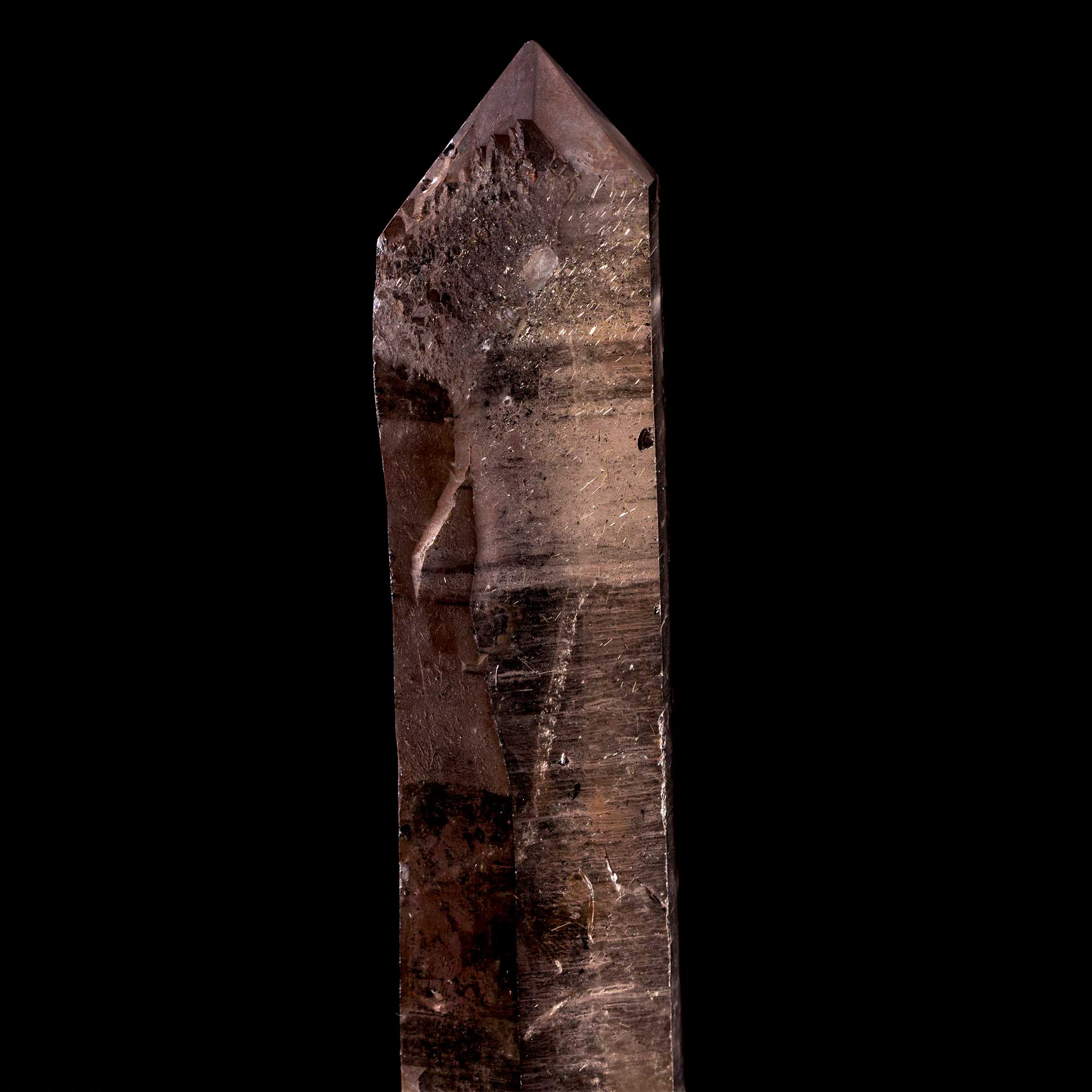
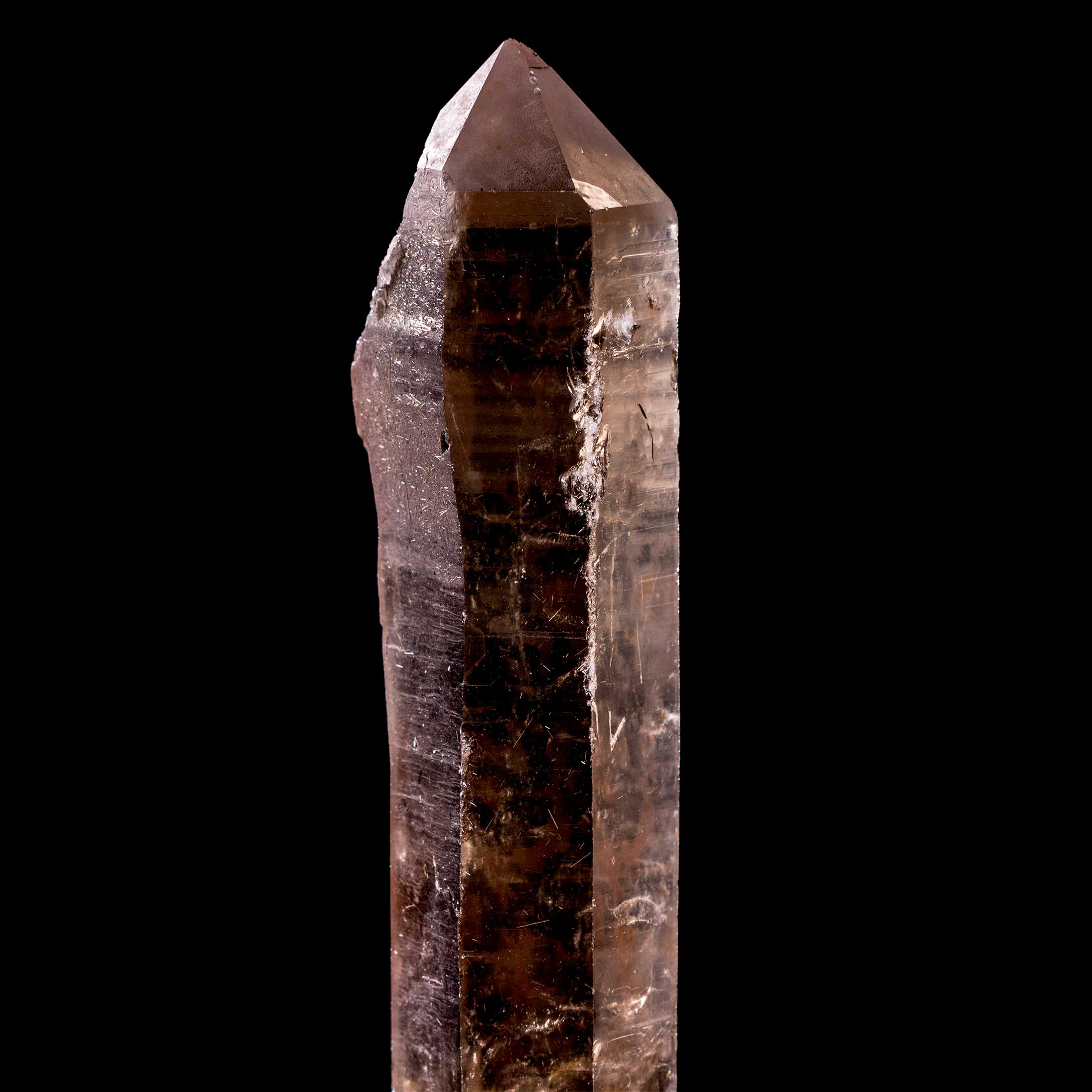
Check out this – Hematite Included Smoky Quartz Laser Wand with Golden Rutilates – Stunning! This Laser Wand has great clarity and grounding properties!! The removable base featuring New Zealand Paua shell comes with the crystal! This specimen is in excellent condition.
Out of stock
Use the tabs below to explore crystal origins, geological details, crystal care guidance, and metaphysical insights.
Click/Tap Buttons to Jump to Section
Rutilated Quartz is one of the most visually striking and energetically dynamic members of the Quartz family. These crystals contain needle-like inclusions of Rutile—titanium dioxide—embedded within Quartz, creating dramatic internal patterns that range from fine hair-like threads to bold, dense lattices.
Historically, Rutilated Quartz has been regarded as a crystal of acceleration and activation. Its unique internal structure gives it a distinctly “wired” quality, often described as highly electromagnetic and immediately responsive when worked with consciously.
Rutilated Quartz is found in several regions worldwide, with notable sources including Brazil, Madagascar, Pakistan, and parts of Africa. Each locality produces distinctive rutile coloration, density, and patterning.
Rutilated Quartz is composed of silicon dioxide (SiO₂) with inclusions of Rutile (TiO₂). Rutile forms before or during Quartz crystallization, becoming encapsulated as the Quartz grows.
| Property | Value |
|---|---|
| Mineral Species | Quartz with Rutile inclusions |
| Chemical Formula | SiO₂ + TiO₂ |
| Crystal System | Trigonal (Quartz) / Tetragonal (Rutile) |
| Hardness (Mohs Scale) | 7 (Quartz), 6–6.5 (Rutile) |
| Luster | Vitreous to metallic (internal) |
| Transparency | Transparent to translucent |
| Defining Feature | Needle-like Rutile inclusions |
⚠️ Handling:
Handle carefully to preserve clarity and internal inclusion structure. Avoid sharp impacts.
🧼 Cleaning:
Water-safe for brief rinsing. Avoid prolonged soaking if fractures are present.
☀️ Light:
Generally light-stable. Display lighting enhances internal Rutile brilliance.
📦 Storage & Display:
Store separately to avoid scratching polished surfaces. Display where internal structure is visible.
Click/Tap Buttons to Jump to Section
Smoky Quartz is one of the most practical, grounding, and widely used Quartz varieties and is often considered a default crystal in healing layouts. Its naturally smoky coloration ranges from light translucent brown through to deep smoky grey and near-black tones.
Smoky Quartz forms when Clear Quartz is exposed to natural radiation within the Earth over long periods, causing aluminum impurities in the crystal lattice to change the way light is absorbed. This process is entirely natural and produces a grounding, stabilizing crystal with remarkable resilience.
Morion Crystals are a very dark to opaque, nearly black variety of smoky quartz, a brownish-to-black form of quartz crystal colored by natural radiation – it must still be translucent to be termed a “Morion”.
Smoky Quartz may occur as single points, clusters (rare), Elestial formations, Phantoms, and on very rare occasions Cathedral formations. It can also combine naturally with other Quartz varieties such as Amethyst and Citrine, creating powerful hybrid crystals.
Smoky Quartz is composed of silicon dioxide (SiO₂) and crystallizes in the trigonal crystal system, like all Quartz. Its coloration is caused by natural ionizing radiation acting on trace aluminum within the crystal structure.
True Smoky Quartz remains at least partially translucent. Completely opaque specimens are extremely rare and should be treated with caution, as much material on the market is artificially heat-treated Clear Quartz.
| Property | Value |
|---|---|
| Mineral Species | Quartz (Smoky variety) |
| Chemical Formula | SiO₂ |
| Crystal System | Trigonal |
| Hardness (Mohs Scale) | 7 |
| Luster | Vitreous |
| Transparency | Translucent to transparent |
| Defining Feature | Natural radiation-induced coloration |
A significant amount of Smoky Quartz on the market is artificially heated Clear Quartz. Majestic Quartz goes to great lengths to only natural Smoky Quartz.
⚠️ Handling:
Smoky Quartz is durable and well suited for frequent handling and healing work.
🧼 Cleaning:
Water-safe for brief rinsing. Avoid prolonged soaking if inclusions or fractures are present. Dry thoroughly.
☀️ Light:
Prolonged intense sunlight may gradually fade color in some specimens.
📦 Storage & Display:
Smoky Quartz performs best when actively used rather than stored away. Ideal for daily grounding and protection.
Flat Rate Shipping of only $6 – $9 USD equivalent, add as many items as you like!
 Guaranteed Safe Checkout


