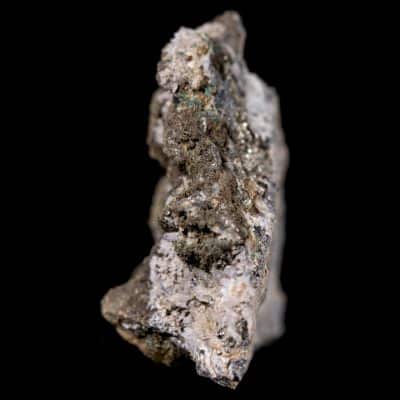
Weight – (without base) 2.37 oz’s – 67.2 gm’s
Dimensions – (without base) 2.831″ x 1.484″ long/wide (7.192 x 3.769 cm’s)
Country of Origin – Colombia



USD $36.00
SKU: Q3306
This Natural Hematite Included Fire Quartz Point is a spectacular display of Hematite Fire Quartz! Wow!! The whole thing is natural with great clarity and luster.
In stock
Use the tabs below to explore crystal origins, geological details, crystal care guidance, and metaphysical insights.
Weight – (without base) 2.37 oz’s – 67.2 gm’s
Dimensions – (without base) 2.831″ x 1.484″ long/wide (7.192 x 3.769 cm’s)
Country of Origin – Colombia
Click/Tap Buttons to Jump to Section
Hematite is one of the most important and widely distributed iron minerals on Earth. Its name derives from the Greek word haima, meaning “blood,” referencing the reddish streak Hematite produces when powdered—despite often appearing metallic gray or black in solid form.
Hematite has been used by humans since prehistoric times for pigments, tools, ceremonial objects, and grounding talismans. Today, it remains prized both as a mineral specimen and as a practical stone for grounding and focus.
Major sources of Hematite include Brazil, Australia, South Africa, England, Canada, and the United States. It occurs in massive, botryoidal, tabular, and crystalline forms, as well as polished disks, pendants, and beads.
Hematite is an iron oxide mineral with the chemical formula Fe₂O₃. It crystallizes in the trigonal crystal system and forms in a wide range of geological environments, including sedimentary, metamorphic, and igneous settings.
Hematite is one of the primary ores of iron and plays a major role in Earth’s geologic and industrial history. It often forms alongside Quartz, Magnetite, Goethite, and other iron-rich minerals.
| Property | Value |
|---|---|
| Mineral Species | Hematite |
| Chemical Formula | Fe₂O₃ |
| Crystal System | Trigonal |
| Hardness (Mohs Scale) | 5–6 |
| Luster | Metallic to earthy |
| Color | Steel-gray, black, reddish-brown |
| Streak | Reddish-brown |
| Density | High |
Hematite’s density and iron-rich composition give it a pronounced physical “weight,” which contributes to its long-standing association with grounding and stability.
⚠️ Handling:
Hematite is generally durable, though polished pieces can chip if dropped.
🧼 Cleaning:
Avoid prolonged water exposure, especially for polished or coated pieces. Clean with a dry or slightly damp cloth and dry thoroughly.
☀️ Light:
Light-stable under normal conditions.
📦 Storage & Display:
Store separately from very hard minerals to avoid scratching. Hematite disks and pendants are ideal for daily wear.
Click/Tap Buttons to Jump to Section
Included Quartz refers to Quartz crystals that contain other minerals trapped within them during growth. These inclusions may appear as needles, clouds, veils, phantoms, sprays, plates, threads, or granular deposits, each reflecting the geological conditions present at the time of formation.
Common inclusions include Chlorite, Rutile, Tourmaline, Titanium-bearing minerals, Iron oxides, and many others. Each specimen is inherently unique, as the timing, chemistry, and environment of growth determine the inclusion’s shape, placement, and density.
Included Quartz occurs worldwide, with notable localities in Brazil, Madagascar, Pakistan, India, the United States, and parts of Africa. Because inclusions record a snapshot of the crystal’s growth history, many collectors consider Included Quartz to be a visual and geological record of Earth’s evolving conditions.
Included Quartz is composed of silicon dioxide (SiO₂) and crystallizes in the trigonal crystal system, consistent with all Quartz varieties. The defining feature is the presence of one or more foreign minerals incorporated during crystal growth.
Inclusions form when Quartz grows in environments where other minerals are suspended in hydrothermal fluids. As the Quartz crystal develops, these minerals may become trapped internally rather than being excluded or deposited on the surface. Growth may continue around the inclusion, fully enclosing it within the crystal body.
In some cases, inclusions outline earlier growth stages, forming phantoms. In others, needle-like or fibrous inclusions such as Rutile or Tourmaline grow simultaneously with the Quartz, creating complex internal structures.
| Property | Value |
|---|---|
| Mineral Species | Quartz with mineral inclusions |
| Chemical Formula | SiO₂ (host crystal) |
| Crystal System | Trigonal |
| Hardness (Mohs Scale) | 7 (host crystal) |
| Luster | Vitreous |
| Transparency | Transparent to translucent |
| Defining Feature | Internal mineral inclusions |
From a geological perspective, inclusions provide valuable insight into the temperature, pressure, and chemistry present during crystal formation. Each Included Quartz specimen is effectively a natural archive of its growth environment.
⚠️ Handling:
Included Quartz is generally durable, but internal fractures or delicate inclusions may be present. Handle gently and avoid sudden impacts.
🧼 Cleaning:
Water-safe for brief rinsing. Avoid prolonged soaking, especially for crystals with visible fractures or porous inclusions. Dry thoroughly.
☀️ Light:
Most Included Quartz is light-stable. Some iron-rich inclusions may darken slightly with prolonged intense sunlight.
📦 Storage & Display:
Store separated from harder specimens to prevent chipping. Display securely to protect terminations.
Flat Rate Shipping of only $6 – $9 USD equivalent, add as many items as you like!
 Guaranteed Safe Checkout