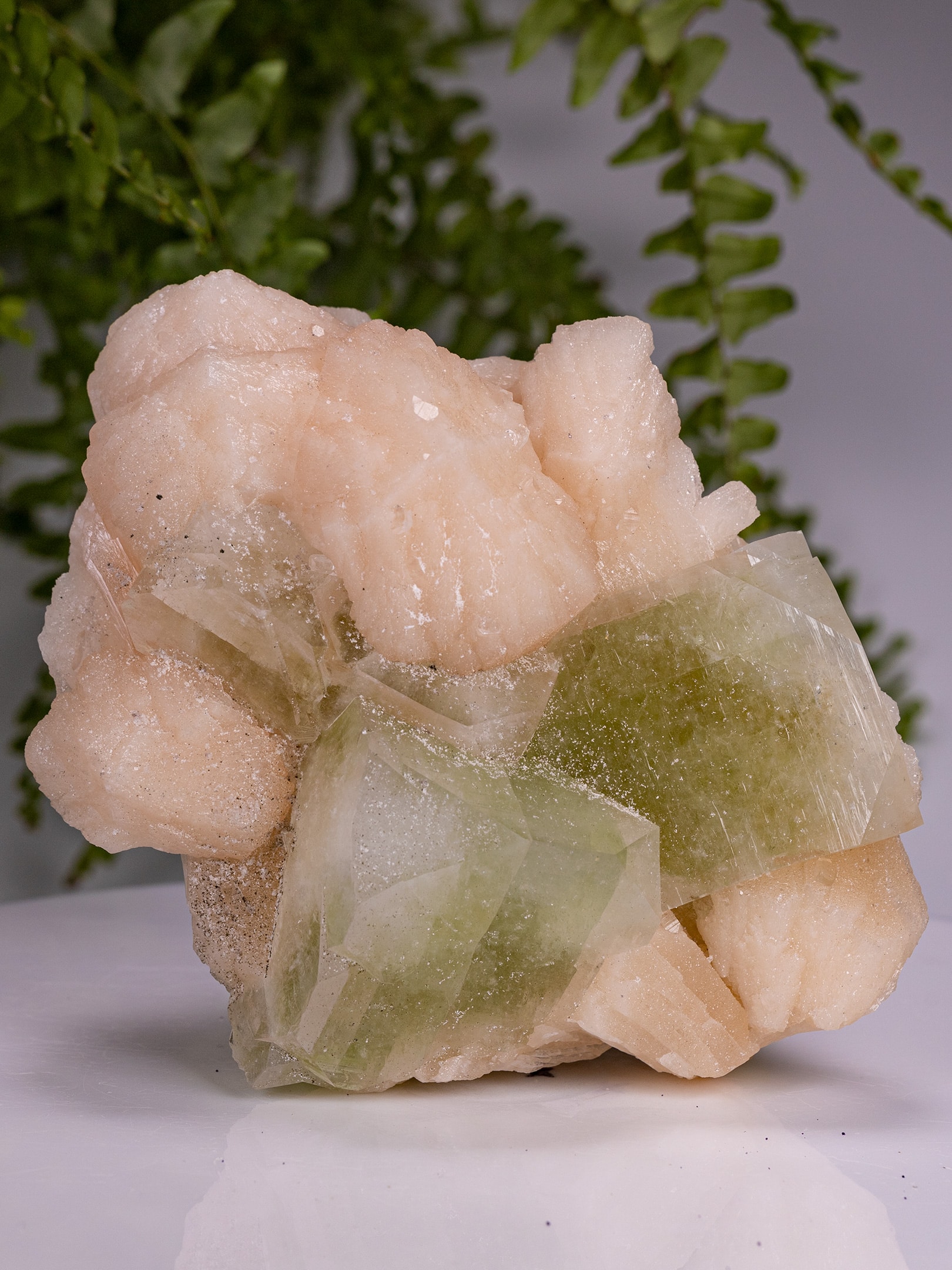
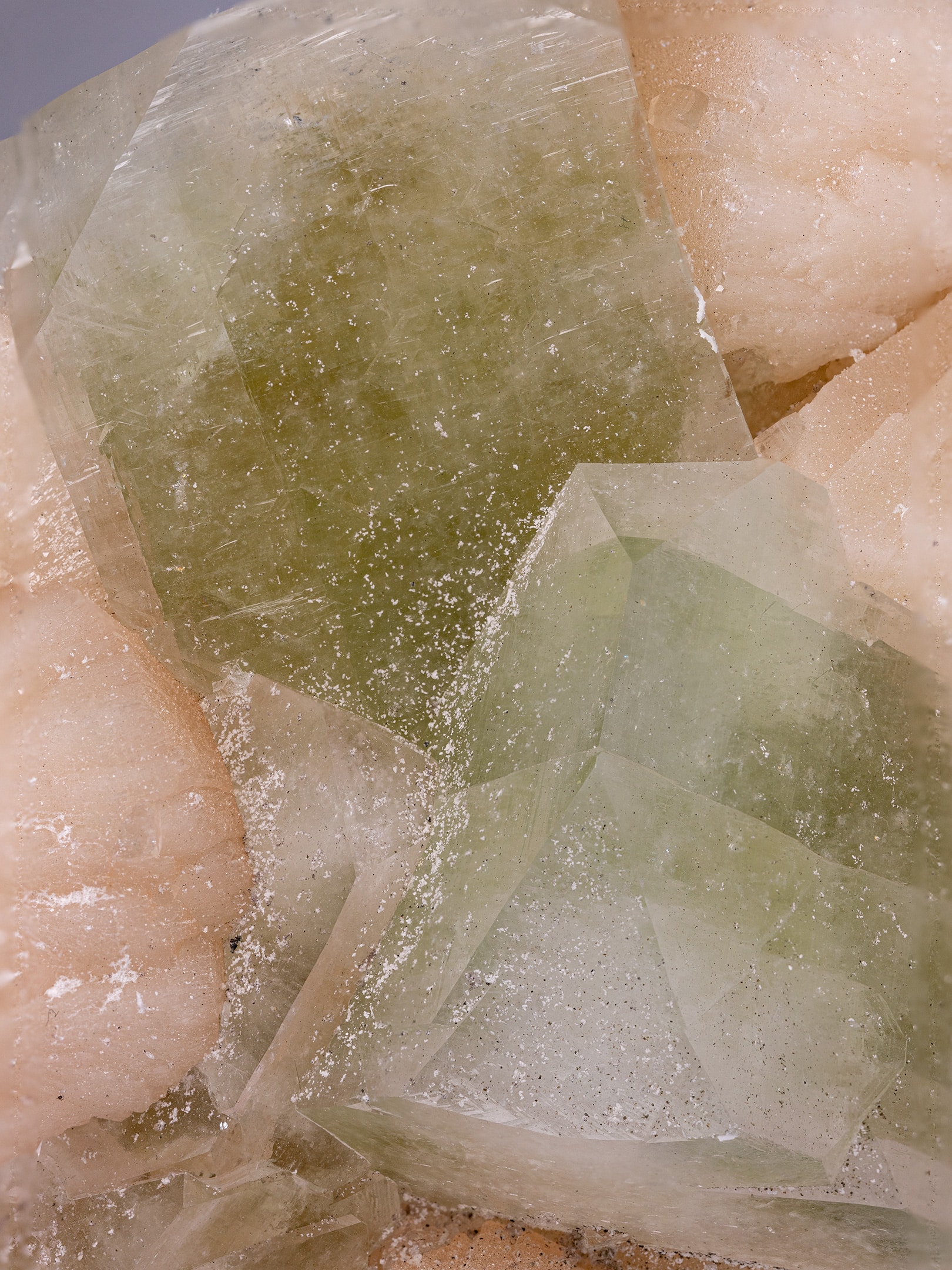
Well-formed green apophyllite crystals with bright natural luster
Soft pink stilbite blades forming a balanced and aesthetic cluster
Strong contrast between translucent green apophyllite and peach-toned stilbite
Multiple clean crystal faces visible across the apophyllite terminations
Classic Indian association piece showcasing two iconic minerals together
Exact crystal shown that you will receive – one of a kind
Specimen Details
Weight
2.0 lb’s (907 g)
Size
5.75 x 4.65 in (14.6 x 11.8 cm)
Origin
India
Crystal Description
This crystal cluster features sharply defined green apophyllite crystals set among softly layered pink stilbite, creating a visually balanced and naturally sculptural composition.
Looking across the cluster, the apophyllite crystals show crisp edges and flat reflective faces, with internal clarity that allows light to pass through in soft green tones. These crystals are well exposed and easy to appreciate from multiple viewing angles.
The pink stilbite forms bladed and fan-like aggregates that wrap around and support the apophyllite, adding warmth and texture to the overall structure. Under directional light, the stilbite displays a gentle pearly sheen that contrasts nicely with the glassy apophyllite.
Together, these features create a classic Indian association specimen that highlights the natural growth relationship between the two minerals. The cluster remains well balanced and freestanding, making it an excellent display piece for collectors who appreciate clean crystal form and complementary mineral pairings.
Click/Tap Buttons to Jump to Section
Apophyllite Origins & Background
Apophyllite is a mineral group rather than a single species, best known for its bright, reflective crystal faces and exceptionally high light transmission. It is often immediately recognizable by its glassy luster and natural sparkle.
The name Apophyllite comes from the Greek words apo (away) and phyllon (leaf), referring to the mineral’s tendency to flake or exfoliate when heated — a property noted by early mineralogists.
Apophyllite most commonly forms as well-defined prismatic or pyramidal crystals, often with a square or rectangular cross-section. These crystals frequently grow in clusters and are commonly associated with other zeolite minerals such as Stilbite, Heulandite, and Chalcedony.
Major sources of Apophyllite include India (particularly the Deccan Traps), Brazil, Mexico, Iceland, and parts of Germany.
Apophyllite belongs to a group of hydrated potassium-calcium silicate minerals. It commonly forms in volcanic basalt cavities where mineral-rich fluids slowly crystallize under stable conditions.
Crystals grow with strong cleavage in multiple directions, which is why Apophyllite often displays extremely flat, mirror-like faces. These planes reflect light efficiently, giving the crystal its distinctive luminous appearance.
Apophyllite can occur in several color varieties, including clear/colorless, white, green, peach, and yellow. Color variations are influenced by trace elements and growth conditions.
Common Geological Occurrences
Volcanic basalt cavities
Zeolite-rich environments
Association with Stilbite, Heulandite, and Chalcedony
⚠️ Handling: Apophyllite has perfect cleavage and can chip or flake easily. Handle gently, especially clusters.
☀️ Sunlight & Heat: Generally stable in indirect light, but avoid excessive heat which may damage crystal structure.
🧼 Cleaning: Avoid water immersion. Clean gently with a soft, dry brush or compressed air.
📦 Storage & Display: Display in a protected location away from vibration or frequent handling. Apophyllite displays beautifully under soft, indirect lighting.
Apophyllite is all about light — bringing it into all aspects of the self and helping one actively work with that light to enhance life on every level.
This crystal supports the release of long-held negativity by illuminating previously dark or stagnant inner spaces. In doing so, it provides healing, clarity, and the seeding of new growth for the mind, spirit, and soul.
Although Apophyllite operates at a very high vibration, it also brings perspective and balance. Rather than pulling one out of the physical world, it helps keep awareness centered while expanding consciousness.
Simply having Apophyllite in one’s presence — whether carried as a single crystal or placed as a cluster in the environment — is often described as filling the space with light. Many people experience a noticeable uplift in mood and clarity when working with this crystal.
Apophyllite is strongly associated with angelic and higher guidance realms. Meditating with it is often described as listening to a subtle, uplifting “song” — a gentle reminder of connection, reassurance, and higher perspective.
Practical & Everyday Uses
Apophyllite is ideal for meditation spaces, healing rooms, or anywhere clarity and upliftment are desired. House gridding with Apophyllite clusters is commonly used to bring light and harmony into living spaces.
Apophyllite Crystal Pairings & Synergy
Apophyllite pairs beautifully with stones that support grounding and integration.
It is often combined with Clear Quartz to amplify light, Stilbite for gentle emotional integration, and Smoky Quartz to ground high-frequency insight into daily life.
Apophyllite Cleansing & Charging — Safe Methods First
⚠️ Important: Apophyllite is sensitive to water and physical stress.
Water safety: Not water-safe. Avoid rinsing or soaking.
Recommended crystal-safe methods:
Sound: singing bowls, bells.
Moonlight: gentle overnight exposure.
Intention / meditation: visualization or prayer.
Selenite plate: dry, supportive cleansing.
If unsure: choose dry, non-contact cleansing methods.
Stilbite is a member of the Zeolite mineral group and is best known for its distinctive sheaf-like or fan-shaped crystal clusters. The name Stilbite comes from the Greek word stilbein, meaning “to shine,” a reference to its pearly to vitreous luster.
Stilbite commonly forms in volcanic environments, particularly within gas cavities of basalt flows. These cavities allow crystals to grow freely, resulting in the elegant radiating clusters that collectors prize.
Major sources of Stilbite include India (especially the Deccan Traps), Iceland, Norway, Scotland, the Faroe Islands, Brazil, and the United States. Indian Stilbite specimens are particularly renowned for their size, color, and aesthetic formations.
Stilbite crystals are often found associated with other Zeolite minerals such as Apophyllite, Heulandite, and Calcite. These mineral groupings provide important clues about the low-temperature hydrothermal processes that formed them.
From a metaphysical perspective, Stilbite is traditionally regarded as having a light, uplifting, and harmonizing energy that encourages gentle expansion of awareness.
Stilbite is a hydrated calcium sodium aluminum silicate and belongs to the Zeolite family of minerals. It forms when mineral-rich water percolates through volcanic rock, depositing crystals in open cavities over long periods of time.
Physical Properties
Property
Value
Mineral Group
Zeolite
Chemical Formula
NaCa₄Al₉Si₂₇O₇₂·28H₂O
Crystal System
Monoclinic
Hardness (Mohs)
3.5 – 4
Luster
Pearly to vitreous
Transparency
Transparent to translucent
Common Colors
White, peach, pink, yellow, colorless
Typical Associations
Apophyllite, Heulandite, Calcite
Stilbite’s softness and high water content make it sensitive to environmental changes, which is why careful handling and storage are recommended.
⚠️ Handling: Stilbite is relatively soft and can cleave easily. Handle gently and avoid pressure on crystal fans and terminations.
🧼 Cleaning: Do not soak in water. Use a soft brush, air blower, or dry cloth to remove dust. Brief misting is acceptable but should be followed by thorough drying.
☀️ Light & Heat: Avoid prolonged exposure to direct sunlight or heat, as dehydration can damage the crystal structure.
📦 Storage: Store in a padded container or display case away from harder minerals.
Stilbite carries a gentle, uplifting, and joyful energy. It is often described as having a distinctly angelic quality that encourages calm, inspiration, and emotional openness.
Practical Ways to Work with Stilbite
Meditation & Stillness Sit quietly and gaze upon a Stilbite cluster. Allow your breathing to slow and your awareness to soften. This crystal supports peaceful states and elevated perception.
Creative Inspiration Place Stilbite in a creative workspace to stimulate artistic expression and imaginative flow. Its energy encourages originality without mental strain.
Personal Energy & Motivation Working with Stilbite near the solar plexus can help energize personal willpower, making it especially useful when undertaking large or long-term projects.
Pattern Release Used consistently, Stilbite supports gentle release of outdated habits and emotional patterns, allowing change to occur without force.
Stilbite Crystal Pairings & Synergy
Stilbite works beautifully with Selenite for higher clarity, Apophyllite for enhanced awareness, and Clear Quartz to amplify intention.
Stilbite Cleansing & Energetic Maintenance
Recommended methods:
Sound cleansing
Moonlight exposure
Selenite charging
Conscious intent
Avoid:
Water soaking
Salt cleansing
Summary
Stilbite is a crystal of joy, inspiration, and gentle transformation. Its soft yet uplifting presence makes it a beautiful companion for meditation, creativity, and navigating meaningful change with grace and clarity.





 Guaranteed Safe Checkout


