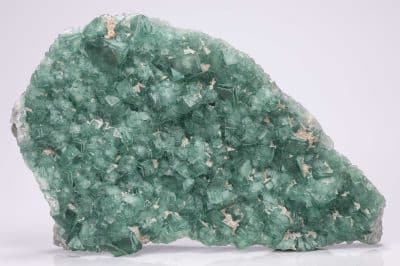
- Natural quartz crystals growing on rich green clinochlore matrix
- High-contrast display piece with sparkling crystal points
- Well-balanced cluster with strong natural texture and depth
- Collected from Colombia
| Specimen Details | |
|---|---|
| Weight |
2.36 oz (67 g) |
| Size |
2.72 x 2.64 in (6.9 x 6.7 cm) |
| Origin | Colombia |
Crystal Description
This natural Colombian specimen features clear to lightly translucent quartz crystals scattered across a deep green clinochlore matrix. The contrast between the bright crystal faces and the dark, granular chlorite-rich base gives the piece a striking visual presence.
Read More →
The quartz crystals are naturally formed, displaying sharp terminations and reflective faces that catch the light from multiple angles. They emerge organically from the clinochlore surface, creating a layered, mineralogical composition that highlights natural growth patterns rather than symmetry.
The green clinochlore matrix provides a rugged, textured foundation, enhancing both contrast and depth. This piece stands well for display and offers strong visual interest from multiple viewing angles, making it a compelling addition for collectors of Colombian minerals or quartz-on-matrix spec
Click/Tap Buttons to Jump to Section
Quartz Cluster Origins & Background
Quartz Clusters are natural groupings of multiple Quartz crystal points growing together on a shared base. Each point retains its own termination while remaining energetically and structurally connected to the whole. This formation allows Quartz Clusters to function as collective radiators of energy rather than single directional tools.
Clusters form in open cavities where many crystals nucleate simultaneously under stable conditions. Because of this cooperative growth, clusters are often viewed as symbols of unity, cooperation, and shared purpose.
Quartz Clusters can occur in Clear Quartz, Smoky Quartz, Amethyst, Citrine, and many other Quartz varieties, with each type adding its own character to the cluster’s overall influence.
Quartz Cluster Geological Information
Quartz Clusters are composed of silicon dioxide (SiO₂) and crystallize in the trigonal crystal system. The clustered habit forms when multiple crystal points grow together from a shared substrate, typically within vugs or cavities in host rock.
Each point within a cluster follows the same crystallographic rules as individual Quartz crystals, but the collective arrangement allows for multidirectional growth and energy dispersion.
Physical Properties
| Property | Value |
|---|---|
| Mineral Species | Quartz (Cluster formation) |
| Chemical Formula | SiO₂ |
| Crystal System | Trigonal |
| Hardness (Mohs Scale) | 7 |
| Luster | Vitreous |
| Transparency | Transparent to translucent |
| Defining Feature | Multiple naturally terminated points |
Structural Advantage of Clusters
Because each point radiates outward, clusters naturally disperse energy in all directions rather than focusing it in a single beam. This makes them ideal for environmental work, group settings, and energetic stabilization of larger spaces.
Quartz Cluster Crystal Care & Ownership Advice
⚠️ Handling:
Lift Quartz Clusters from the base rather than individual points. Terminations can chip if knocked together.
🧼 Cleaning:
Water-safe for brief rinsing. Avoid prolonged soaking if fractures or inclusions are present. Dry thoroughly.
☀️ Light:
Clear Quartz Clusters are light-stable. Amethyst or Smoky varieties should be protected from prolonged intense sunlight.
📦 Storage & Display:
Display where the cluster can radiate freely. Avoid stacking heavy objects on top of points.
Click/Tap Buttons to Jump to Section
Clear Quartz Origins & Background
Clear Quartz is the most widespread and versatile form of Quartz, valued for its transparency, structural clarity, and wide range of natural growth habits. Composed of silicon dioxide, it forms in diverse geological environments and is found on every continent.
Throughout history, Clear Quartz has been used by cultures worldwide for tools, ornamentation, ceremonial objects, and symbolic practices. Its clarity and durability made it a natural focal point for observation, reflection, and intention-based work long before modern terminology existed.
While Clear Quartz occurs globally, certain localities are especially prized for exceptional quality. Colombian Clear Quartz, particularly from high-altitude Andean regions, is widely regarded among collectors and practitioners as some of the highest-quality Clear Quartz in the world. These crystals are known for their exceptional clarity, brightness, and refined growth, often displaying high-frequency visual purity with minimal internal disruption.
Other notable sources include Brazil, Arkansas (USA), Madagascar, Himalayan regions, and Alpine environments, each producing distinctive variations in form and internal character.
Clear Quartz Geological Information
Clear Quartz is composed of silicon dioxide (SiO₂) and crystallizes in the trigonal crystal system. It commonly forms in hydrothermal veins, pegmatites, and igneous, metamorphic, and sedimentary environments.
Quartz crystals grow when silica-rich fluids cool and crystallize over extended periods. The clarity of Clear Quartz depends on growth stability, temperature consistency, and the absence of inclusions during formation.
Clear Quartz may occur as single points, clusters, twin crystals, or specialized growth formations. Its hardness and chemical stability make it one of the most durable naturally occurring minerals.
Physical Properties
| Property | Value |
|---|---|
| Mineral Species | Quartz (Clear / Rock Crystal) |
| Chemical Formula | SiO₂ |
| Crystal System | Trigonal |
| Hardness (Mohs Scale) | 7 |
| Luster | Vitreous |
| Transparency | Transparent to translucent |
| Fracture | Conchoidal |
| Typical Formation | Hydrothermal veins, pegmatites, igneous & metamorphic rocks |
Clear Quartz Crystal Care & Ownership Advice
⚠️ Handling:
Clear Quartz is durable but crystal points and terminations can chip if knocked. Lift from the base when possible.
🧼 Cleaning:
Water-safe for brief rinsing. Avoid prolonged soaking if fractures or inclusions are present. Dry thoroughly.
☀️ Light:
Clear Quartz is light-stable and safe for normal display conditions.
📦 Storage & Display:
Store separately from softer minerals to prevent scratching. Stable display helps preserve terminations and clarity.
Click/Tap Buttons to Jump to Section
Colombian Quartz Origins & Background
Colombian Quartz is widely regarded as one of the finest and most energetically refined forms of Clear Quartz found anywhere in the world. Sourced from high-altitude regions of the Colombian Andes, these crystals are celebrated for their exceptional clarity, brightness, and highly ordered internal structure.
Many Colombian Quartz crystals display Lemurian-style striations—distinct horizontal growth lines along the crystal faces—which has made them especially sought after within the Lemurian Seed Crystal community. These striations are natural growth features and not unique to Colombia, but the combination of clarity, formation quality, and surface refinement seen in Colombian material is considered exceptional.
Nearly all Colombian Quartz is associated with what is commonly referred to as the Silver Light family of Quartz crystals. This term is used descriptively rather than mineralogically, reflecting the perceived clarity, neutrality, and high coherence traditionally attributed to this material.
In recent years, Colombian Quartz has been marketed under a wide range of alternative names, often accompanied by dramatic price increases. While branding terms may vary, experienced collectors and practitioners widely recognize that these crystals originate from the same geological sources and share the same inherent properties. As always in the mineral world, informed sourcing and discernment are essential.
Colombian Quartz Geological Information
Colombian Quartz is composed of silicon dioxide (SiO₂) and crystallizes in the trigonal crystal system, like all Quartz varieties. What distinguishes Colombian material is not its chemistry, but the geological conditions under which it forms.
These crystals grow in high-altitude hydrothermal environments characterized by stable temperatures, low contamination, and prolonged undisturbed growth. Such conditions favor exceptional transparency, sharply defined crystal faces, and minimal internal fracturing or inclusion.
Many Colombian Quartz points grow as single, elegant terminations rather than dense clusters, further contributing to their reputation for structural purity and visual refinement. Lemurian-style striations, when present, are the result of rhythmic growth pulses during crystallization.
Physical Properties
| Property | Value |
|---|---|
| Mineral Species | Quartz (Colombian Clear Quartz) |
| Chemical Formula | SiO₂ |
| Crystal System | Trigonal |
| Hardness (Mohs Scale) | 7 |
| Luster | Vitreous |
| Transparency | Highly transparent to translucent |
| Growth Features | Lemurian-style striations, refined terminations |
| Typical Formation | High-altitude hydrothermal veins |
Colombian Quartz Crystal Care & Ownership Advice
⚠️ Handling:
Although Quartz is durable, Colombian Quartz often features exceptionally fine terminations and surface detail. Lift from the base and avoid pressure on points or striated faces.
🧼 Cleaning:
Water-safe for brief rinsing. Avoid prolonged soaking if internal fractures are present. Dry thoroughly to preserve surface brilliance.
☀️ Light:
Colombian Quartz is light-stable and suitable for normal display conditions.
📦 Storage & Display:
Store separately from softer minerals to prevent abrasion. Stable display preserves both physical integrity and visual refinement.
Click/Tap Buttons to Jump to Section
Chlorite Included Quartz Origins & Background
Chlorite Included Quartz is a natural Quartz crystal containing inclusions of Chlorite, a green phyllosilicate mineral group commonly associated with low-grade metamorphic environments. These inclusions may appear as wispy clouds, mossy veils, granular coatings, or distinct internal landscapes suspended within the Quartz.
In some specimens, Chlorite inclusions form phantoms—internal outlines of earlier growth stages of the Quartz crystal. This occurs when a layer of Chlorite settles on the crystal surface during growth, after which Quartz continues to crystallize over it. The result is a visible “snapshot” of the crystal at that moment in time. Multiple growth interruptions can produce multi-layered phantom formations.
Chlorite Included Quartz is found in a variety of Quartz-bearing regions, including Brazil, Pakistan, India, the Himalayas, Colombia, and parts of the United States. Each locality produces distinct inclusion styles ranging from light green dusting to deep forest-green phantoms.
This material is sometimes confused with moss agate or artificially enhanced Quartz. Genuine Chlorite Included Quartz shows inclusions fully enclosed within natural Quartz growth, not surface staining or dye.
Chlorite Included Quartz Geological Information
Chlorite Included Quartz is composed of silicon dioxide (SiO₂) crystallizing in the trigonal crystal system, with Chlorite inclusions incorporated during growth. Chlorite itself is a group of hydrous magnesium, iron, and aluminum silicate minerals that typically form during metamorphism or hydrothermal alteration.
As Quartz crystals grow in mineral-rich fluids, fine Chlorite particles may settle onto crystal faces or remain suspended within the solution. Continued Quartz growth encapsulates these particles, preserving them as internal inclusions or phantom layers.
The presence of Chlorite does not significantly alter the hardness of Quartz, though heavily included specimens may have internal planes or zones that require careful handling.
Physical Properties
| Property | Value |
|---|---|
| Mineral Species | Quartz with Chlorite inclusions |
| Chemical Formula | SiO₂ (Quartz) + Chlorite group inclusions |
| Crystal System | Trigonal |
| Hardness (Mohs Scale) | 7 |
| Luster | Vitreous |
| Transparency | Transparent to translucent |
| Inclusion Type | Chlorite (green phyllosilicate minerals) |
| Special Features | Phantoms, internal landscapes, growth zoning |
Chlorite Included Quartz Crystal Care & Ownership Advice
⚠️ Handling:
Handle from the base to protect crystal terminations. Included Quartz may have internal planes that benefit from gentle treatment.
🧼 Cleaning:
Generally water-safe for brief rinsing. Avoid prolonged soaking, especially if the crystal contains fractures. Dry thoroughly.
☀️ Light:
Chlorite Included Quartz is light-stable. Normal display lighting is safe.
📦 Storage & Display:
Store separately or padded to prevent abrasion from harder minerals. Stable display helps preserve clarity and internal detail.
 Guaranteed Safe Checkout