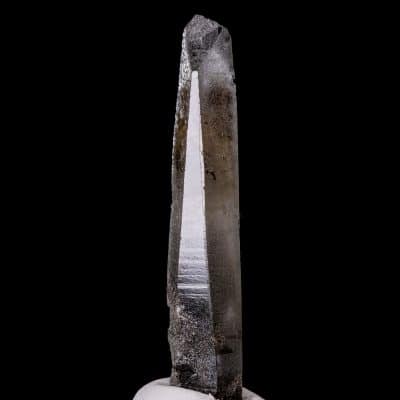
Distinct tabular laser-wand quartz growth with elongated, slender form
Visible multi-layered chlorite phantom structures preserved within the crystal body
Clear to lightly veiled quartz allowing internal inclusions to be easily observed
Localized limonite inclusion adding earthy contrast and natural character
Well-defined terminations with natural growth striations along the faces
Exact crystal shown that you will receive – one of a kind
Specimen Details
Weight
0.56 oz (15.9 g)
Size
2.64 x 0.65 in (6.71 x 1.66 cm)
Origin
Colombia
Crystal Description
This Colombian quartz crystal presents a striking tabular laser-wand form, with a clear, elongated body that allows the internal landscape to be easily seen as light moves across the faces.
Looking into the crystal, you can see multiple layers of chlorite phantom growth captured at different stages, creating a stacked, dimensional effect within the quartz. These phantoms appear as soft green bands that follow the original crystal outlines.
The quartz itself shows natural growth striations and a crisp termination, reinforcing its laser-like profile. Its tabular structure gives the piece a refined, architectural appearance that stands out among more typical prismatic forms.
A small limonite inclusion is present along one side, adding a warm, earthy accent that contrasts with the cooler tones of the chlorite and clear quartz. Together, these features make this crystal a visually engaging and highly collectible example from Colombia.
Click/Tap Buttons to Jump to Section
Phantom Quartz Origins & Background
Phantom Quartz is one of the most symbolically powerful growth forms in the Quartz family. These crystals contain visible internal “phantoms” — ghost-like images of earlier stages of the crystal’s own development preserved within the body of the crystal itself.
Each phantom represents a pause, interruption, or shift during the crystal’s growth cycle. Rather than halting development permanently, the Quartz resumes growth and carries the record of that moment forward. Because of this, Phantom Quartz has long been associated with evolution, resilience, and the ability to move forward after disruption.
Phantom Quartz occurs in many Quartz varieties, including Clear Quartz, Smoky Quartz, Amethyst, and included forms. Each variety adds its own nuance to the phantom’s expression and influence.
Phantom Quartz forms when a crystal’s growth is temporarily interrupted by the introduction of another substance or a change in environmental conditions. This interruption leaves a visible layer on the crystal’s termination before growth resumes, encapsulating that earlier stage within the final crystal.
Common Phantom-Causing Materials
Chlorite: often green phantoms
Hematite: red, brown, or metallic phantoms
Clay or sediment: pale or earthy-toned phantoms
Thermal changes: color-zone phantoms (often Smoky or Amethyst)
3D Phantom Formation
The most powerful and visually striking phantoms are referred to as 3D phantoms. In these specimens, the interrupting material fully coats the termination, creating a complete three-dimensional “crystal within a crystal.”
Phantom Quartz is fundamentally a crystal of growth through experience. Each internal phantom represents a milestone — a moment where growth paused, adapted, and continued stronger than before.
Growth, Integration & Moving Forward
Phantom Quartz is especially helpful when we feel stuck, stalled, or defined by past challenges. It teaches that interruption does not equal failure — it is simply part of the evolution process.
The type of inclusion forming the phantom influences the specific lessons and support the crystal offers, adding layers of meaning and applicability.
Milestones, Planning & Projection
Because phantoms mark distinct stages of growth, these crystals are often used to:
Mark personal milestones
Project future growth phases
Reframe past challenges as achievements
Practical Ways to Work With Phantom Quartz
Growth Reflection Exercise: Hold the Phantom Quartz and reflect on a time when growth felt interrupted. Acknowledge how that moment strengthened you rather than diminished you.
Blockage Release: Meditate with the crystal over the heart or solar plexus, visualizing old blockages dissolving into markers of wisdom.
Milestone Programming: Program the crystal with a future goal, viewing each step as a “phantom” that marks progress rather than delay.
Self-Healing Visualization: Visualize the phantom layer as a testament to survival and strength, then bring that perfected strength forward into the present.
Guided Phantom Integration Exercise
Hold a Phantom Quartz and recall a challenging or traumatic period that you feel may have limited your growth. Now consciously reinterpret that experience as a foundation rather than an obstacle. See it as a visible marker of strength — just as the phantom marks the crystal’s growth.
Allow gratitude to replace resistance. Thank the Phantom Quartz for assisting in reframing the experience and facilitating self-healing.
Phantom Quartz Crystal Pairings & Synergy
Phantom Quartz works exceptionally well with Smoky Quartz for grounding growth, Amethyst for insight, and Hematite to anchor lessons into physical reality.
Phantom Quartz Cleansing & Charging — Honor the Journey
⚠️ Important: Phantom Quartz responds best to intentional, respectful cleansing.
Recommended methods:
Sound: bowls or tuning forks.
Moonlight: gentle overnight renewal.
Intention: consciously acknowledge growth cycles.
Summary
Phantom Quartz is a profound teacher of growth, resilience, and transformation. By preserving every stage of its journey, it reminds us that nothing is wasted — every experience contributes to who we are becoming.
Lemurian Seed Quartz is one of the most distinctive and widely recognized formation types within the Quartz family. These crystals are identified by their horizontal striated lines that run across alternating faces of the crystal—one face striated, the next smooth, and so on around the prism.
This alternating pattern is consistent, deliberate, and unmistakable once recognized. Lemurian Seed crystals are not cut or artificially altered; the striations are a natural growth feature that defines the formation.
Lemurian Seed Quartz is considered a major crystal category at Majestic Quartz due to both its unique physical characteristics and the depth of traditional knowledge associated with it.
Lemurian Seed Quartz is composed of silicon dioxide (SiO₂) and crystallizes in the trigonal crystal system, like all Quartz. The defining feature is the presence of pronounced horizontal striations on alternating prism faces.
These striations are growth markings that reflect episodic development during crystal formation. Variations in temperature, pressure, and solution chemistry during growth cycles create subtle step-like ridges along the crystal faces.
Lemurian Seed Quartz is found in multiple locations worldwide, including Colombia, Brazil, Madagascar, the Himalayas, and other Quartz-producing regions. The Lemurian growth habit can occur in Clear Quartz, Smoky Quartz, Citrine Quartz, and included varieties, each expressing the Lemurian pattern in its own way.
Lemurian Seed Quartz is traditionally regarded as an advanced master crystal with a strong focus on intuition, knowledge transmission, and long-term human development.
These crystals are associated with the ancient civilization of Lemuria and are often described as tools used by advanced beings to store, transmit, and preserve information related to technology, DNA, social systems, and collective evolution.
The Striations as Timelines
The horizontal striations on Lemurian Seed Quartz are traditionally understood as recorded timelines—markers of significant developmental stages in human history and consciousness.
A commonly used analogy is technological progression: phonograph records, cassette tapes, compact discs, and modern digital streaming. Each advancement can be viewed as a single striated line. Together, they form a layered record of evolution.
Practical Exercise — Reading the Striations
Hold the Lemurian Seed Quartz comfortably.
Run your fingertips slowly across the striated faces.
Clear the mind and remain receptive.
Allow impressions, images, or feelings to surface.
This technique is a primary way of interfacing with Lemurian knowledge. Information may be received consciously or stored subconsciously for later intuitive access.
Intuition & Personal Interface
Lemurian Seed Quartz strongly encourages intuitive interaction. There is no single correct way to work with these crystals. Trusting personal intuition is not only natural but essential when accessing the information they carry.
Lemurian Seed Quartz by Variety
Smoky Quartz Lemurians: Ground extremely high vibration into the mind, body, and soul.
Citrine Quartz Lemurians: Support self-esteem and assist DNA in adapting to life in the technological age.
Clear Quartz Lemurians: Balance emotional and spiritual bodies while promoting creative and innovative solutions.
Hematite Included Pink & Blood Red Lemurians: Strengthen connection to Earth Mother while grounding creative energy and boosting physical vitality for completing meaningful projects.
Lemurian Seed Quartz Crystal Pairings & Synergy
Lemurian Seed Quartz works exceptionally well with Black Tourmaline to anchor high-frequency insight, Selenite for refined light integration, and grounding stones to support embodiment of knowledge.
⚠️ Important: Lemurian Seed Quartz responds best to respectful, intentional interaction rather than aggressive cleansing.
Recommended crystal-safe options:
Sound: gentle bowls or tones.
Moonlight: overnight exposure.
Touch: regular fingertip interaction.
Summary
Lemurian Seed Quartz is a master crystal line deeply associated with intuition, knowledge preservation, and human evolution. Through its distinctive striations and responsive nature, it serves as a living library—inviting those ready to listen to access wisdom across timelines and apply it for the betterment of humanity as a whole.
Laser Wand Quartz Crystals condense and focus light. They are very powerful light tools indeed!
After reading some books, people may be afraid to even pick them up. I would like to make it clear that they only slice or cut through auras if that is your focused intent.
Laser Wand crystals are very flexible tools and may be used in the following ways (amongst many others).
1. To draw out negativity – Hold the base on the affected area and visualize the negative energy being drawn out and transferred into light as it passes out through the termination. You may prefer to use a soft receiving stone to absorb the negative energy, then cleanse the receiver crystal after the procedure is complete.
2. Put positive energy into a negatively affected area by holding the Laser Wand, moving it in clockwise circles, all the while visualizing white light going into the area requiring it.
3. Use Quartz Laser Wands for color therapy – For example, place a colored tumbled or flat cab/slice (e.g. Amethyst) on your 3rd eye, then place the base of the Laser Wand on the Amethyst and project the Amethyst color through the Laser Wand into the required area. I find this most useful when recharging chakras that may not have responded as well as hoped during a body layout. This technique really adds an extra boost. You can combine this with method 2 above as well.
4. Attach small laserwands to your fingers via rubber bands and touch them to acupressure points, visualizing light passing through the crystals. An advantage of using Laser Wands in this fashion is you do not have to wait for the person to breathe out as you do in acupressure and you can do multiple points at once.
5. Some Laser Wands have singing properties. These crystals are harder than normal Quartz crystals, and are usually very tapered. When you gently tap two Singing Laser Wands together (or even use just your fingernail on one), they make a high pitched “ting” sound. Singing Laser Wands often have a crusty appearance – the crustier they are the higher the pitch and vibration seems to be the general rule! A way to use them is to hold one crystal pointing towards the body, then gently tap the other crystal (or fingernail) onto it. Move the crystal up the body and listen for any changes in tone or pitch. When you reach a blockage you will hear the pitch go dull. Stay in that area and tap the other Laser slightly harder. After a few taps you will hear the pitch go higher again as the blockage is released and or cleared. Continue up the rest of the body as before until all chakras are clear.
6. Clear out clogged veins by visualizing a Laser Wand passing through them. I once used this technique to clear out a blocked plastic vein that had been used as a replacement in an earlier surgery procedure. This technique may also be used for varicose veins. Adding Aquamarine energy into the mix will greatly calm, soothe, and reduce inflammation within the veins, thus complementing the clearing energy of the Laser Wand Quartz Crystal.
These are just some techniques I have used with success. Naturally you can intuitively alter/modify any of the above techniques or come up with completely new ones yourselves!
Read more regarding Laser Wand Quartz Crystal Properties at the link below (will open in a new tab/window)….
Tabular Quartz crystals—often affectionately called “Tabbies”—are distinguished by their flat, plate-like form, where one or more faces are significantly wider than the crystal is thick. This growth habit creates a natural bridge-like geometry that has long been associated with communication, connection, and integration.
Tabular Quartz occurs in various Quartz varieties and may be found as single plates, twins, or stacked formations. Because their formation requires very stable growth conditions, well-formed Tabular Quartz crystals are less common than standard points.
These crystals are widely regarded as cooperative and people-oriented stones, excelling in situations where clarity, understanding, and harmony are needed.
Tabular Quartz is composed of silicon dioxide (SiO₂) and crystallizes in the trigonal crystal system. The tabular habit forms when crystal growth favors lateral expansion along one crystallographic plane, resulting in broad, flat faces.
This growth style reflects long-term stability in the mineralizing environment, allowing the crystal to expand evenly rather than elongate rapidly.
Physical Properties
Property
Value
Mineral Species
Quartz (Tabular growth habit)
Chemical Formula
SiO₂
Crystal System
Trigonal
Hardness (Mohs Scale)
7
Luster
Vitreous
Transparency
Transparent to translucent
Defining Feature
Wide, flat crystal faces
Structural Significance
The flat geometry of Tabular Quartz naturally lends itself to interaction, transfer, and balance—qualities that strongly influence how these crystals are traditionally worked with.
Tabular Quartz is widely regarded as the crystal of communication. Its energy is cooperative, harmonizing, and naturally oriented toward understanding and empathy.
Communication, Empathy & Mediation
Tabular Quartz excels at facilitating clear, constructive communication between people—especially where misunderstandings or emotional tension exist.
A classic use is to place the crystal between two individuals during discussion. The crystal helps soften defensiveness, increase empathy, and support honest yet respectful exchange.
Joy, Humor & Emotional Lightness
These crystals often carry a joyful, playful energy. They are known for helping difficult or unpalatable information be delivered with humor and lightness—making it easier to hear and integrate.
Etheric Integration & Insight
Tabular Quartz assists in grounding and merging the etheric bodies into the physical body. This integration allows knowledge from multiple levels to come together coherently.
Insights often arrive as:
Sudden realizations
Flash visions
Strong intuitive feelings
Practical Ways to Work With Tabular Quartz
Mediation Placement: Place the Tabular Quartz between two people during a conversation to support empathy and mutual understanding.
Communication Meditation: Hold the crystal in both hands, relax the breath, and allow the mind to empty. Ask a clear question once calm is achieved. Release expectation and allow the answer to arrive naturally later.
Insight Integration: Use Tabular Quartz when seeking to merge emotional, mental, and intuitive information into a single clear understanding.
Crystal Charging & Clearing: Place smaller crystals on the flat faces of the Tabular Quartz overnight to gently clear and recharge them.
Delayed Insight — The Eureka Effect
Tabular Quartz often delivers answers when the conscious mind steps aside. Trust that insights may arise unexpectedly—during daily activities, rest, or moments of humor and relaxation.
Tabular Quartz Crystal Pairings & Synergy
Tabular Quartz works beautifully with Rose Quartz for heart-centered communication, Amethyst for calm clarity, and Black Tourmaline to keep conversations grounded and constructive.
Tabular Quartz Cleansing & Charging — Keep the Channel Open
⚠️ Important: Because Tabular Quartz often mediates between people, regular gentle clearing is beneficial.
Recommended methods:
Sound: bowls or bells.
Moonlight: overnight refresh.
Intentional pause: allow the crystal to rest between intensive uses.
Summary
Tabular Quartz is a master communicator—balancing, joyful, and deeply empathetic. Whether mediating conversations, integrating insight, or gently charging other crystals, it brings harmony, humor, and understanding wherever it is placed.
Colombian Quartz is widely regarded as one of the finest and most energetically refined forms of Clear Quartz found anywhere in the world. Sourced from high-altitude regions of the Colombian Andes, these crystals are celebrated for their exceptional clarity, brightness, and highly ordered internal structure.
Many Colombian Quartz crystals display Lemurian-style striations—distinct horizontal growth lines along the crystal faces—which has made them especially sought after within the Lemurian Seed Crystal community. These striations are natural growth features and not unique to Colombia, but the combination of clarity, formation quality, and surface refinement seen in Colombian material is considered exceptional.
Nearly all Colombian Quartz is associated with what is commonly referred to as the Silver Light family of Quartz crystals. This term is used descriptively rather than mineralogically, reflecting the perceived clarity, neutrality, and high coherence traditionally attributed to this material.
In recent years, Colombian Quartz has been marketed under a wide range of alternative names, often accompanied by dramatic price increases. While branding terms may vary, experienced collectors and practitioners widely recognize that these crystals originate from the same geological sources and share the same inherent properties. As always in the mineral world, informed sourcing and discernment are essential.
Colombian Quartz is composed of silicon dioxide (SiO₂) and crystallizes in the trigonal crystal system, like all Quartz varieties. What distinguishes Colombian material is not its chemistry, but the geological conditions under which it forms.
These crystals grow in high-altitude hydrothermal environments characterized by stable temperatures, low contamination, and prolonged undisturbed growth. Such conditions favor exceptional transparency, sharply defined crystal faces, and minimal internal fracturing or inclusion.
Many Colombian Quartz points grow as single, elegant terminations rather than dense clusters, further contributing to their reputation for structural purity and visual refinement. Lemurian-style striations, when present, are the result of rhythmic growth pulses during crystallization.
⚠️ Handling: Although Quartz is durable, Colombian Quartz often features exceptionally fine terminations and surface detail. Lift from the base and avoid pressure on points or striated faces.
🧼 Cleaning: Water-safe for brief rinsing. Avoid prolonged soaking if internal fractures are present. Dry thoroughly to preserve surface brilliance.
☀️ Light: Colombian Quartz is light-stable and suitable for normal display conditions.
📦 Storage & Display: Store separately from softer minerals to prevent abrasion. Stable display preserves both physical integrity and visual refinement.
Colombian Quartz is traditionally regarded as operating at an exceptionally high level of coherence and clarity. Within metaphysical traditions, it is often described as resonating among the highest “vibrational” expressions of Quartz, valued for its purity, neutrality, and precision.
These crystals are commonly associated with seeking truth, alignment with the highest good, and maintaining clarity in complex or emotionally charged situations. Rather than amplifying emotional intensity, Colombian Quartz is often described as supporting emotional neutrality and discernment, making it a favored tool for practitioners who require clear, unbiased perception.
Colombian Quartz is traditionally associated with cleansing and refinement on subtle levels—symbolically linked with clearing mental clutter, emotional residue, and stagnant patterns. Some traditions extend this symbolism to overall vitality and balance, particularly in relation to breath, clarity, and the free flow of energy. These interpretations are energetic and symbolic in nature, not medical claims.
Because of its clarity and amplifying capacity, Colombian Quartz is frequently used in elixir practices, meditation, and advanced energetic work. Its reputation for precision makes it especially valued for intentional, focused applications rather than generalized use.
Nearly all Colombian Quartz is considered part of the Silver Light family, and therefore is traditionally associated with all symbolic qualities attributed to that group, including clarity, integration, and conscious awareness.
Colombian Quartz is traditionally associated with:
Alignment with truth and highest good
Exceptional clarity and energetic coherence
Emotional neutrality and unbiased perception
Refinement and cleansing of subtle awareness
Advanced meditation and practitioner-focused work
Colombian Quartz Crystal Pairings & Synergy
Colombian Quartz pairs exceptionally well with crystals that support grounding, integration, and focused amplification.
It works well alongside Smoky Quartz for grounding clarity, Amethyst for insight, Selenite for refinement, and Hematite to anchor high-frequency work.
Note: Colombian Quartz responds best to clarity of purpose. Take time to consciously align before working with it.
Summary
Colombian Quartz represents the pinnacle of Clear Quartz refinement—exceptionally clear, highly coherent, and deeply respected by collectors and practitioners alike. Valued for truth-seeking, neutrality, and precision, it remains one of the most powerful and versatile Quartz crystals available when approached with knowledge and discernment.



 Guaranteed Safe Checkout