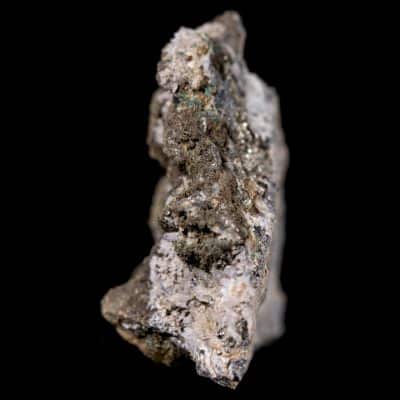
Natural quartz crystal cluster with visible green clinochlore inclusions
Clear to lightly milky quartz points with varied crystal habits
Attractive contrast between transparent quartz and green mineral matrix
Natural, unpolished specimen from Colombia
Specimen Details
Weight
8.78 oz (249 g)
Size
5.31 x 2.24 in (13.5 x 5.7 cm)
Origin
Colombia
Crystal Description
This Colombian quartz cluster features a vertical growth habit with numerous intergrown crystal points accented by natural green clinochlore inclusions. The contrast between the clear to softly milky quartz and the green mineral matrix gives the piece strong visual depth and texture.
The cluster retains its natural form and matrix, making it well suited for collectors who appreciate mineralogical character and natural crystal growth. Read More →
The quartz crystals display varied terminations and overlapping growth, with clinochlore appearing as green granular and mossy inclusions throughout the matrix and between crystal bases. These inclusions add earthy contrast while allowing the quartz points to remain visually prominent.
Sourced from Colombia, this specimen is ideal for display as a standalone crystal cluster or as part of a curated mineral collection, offering both structural interest and natural mineral diversity.
Click/Tap Buttons to Jump to Section
Quartz Cluster Origins & Background
Quartz Clusters are natural groupings of multiple Quartz crystal points growing together on a shared base. Each point retains its own termination while remaining energetically and structurally connected to the whole. This formation allows Quartz Clusters to function as collective radiators of energy rather than single directional tools.
Clusters form in open cavities where many crystals nucleate simultaneously under stable conditions. Because of this cooperative growth, clusters are often viewed as symbols of unity, cooperation, and shared purpose.
Quartz Clusters can occur in Clear Quartz, Smoky Quartz, Amethyst, Citrine, and many other Quartz varieties, with each type adding its own character to the cluster’s overall influence.
Quartz Clusters are composed of silicon dioxide (SiO₂) and crystallize in the trigonal crystal system. The clustered habit forms when multiple crystal points grow together from a shared substrate, typically within vugs or cavities in host rock.
Each point within a cluster follows the same crystallographic rules as individual Quartz crystals, but the collective arrangement allows for multidirectional growth and energy dispersion.
Physical Properties
Property
Value
Mineral Species
Quartz (Cluster formation)
Chemical Formula
SiO₂
Crystal System
Trigonal
Hardness (Mohs Scale)
7
Luster
Vitreous
Transparency
Transparent to translucent
Defining Feature
Multiple naturally terminated points
Structural Advantage of Clusters
Because each point radiates outward, clusters naturally disperse energy in all directions rather than focusing it in a single beam. This makes them ideal for environmental work, group settings, and energetic stabilization of larger spaces.
Quartz Clusters carry all the properties of Quartz, amplified by their collective structure. Where a single Quartz point directs energy, a cluster distributes it—making these crystals ideal for room clearing, group work, and ongoing energetic support.
Environmental Balancing & Space Clearing
Quartz Clusters naturally radiate energy outward, benefiting entire rooms. Large clusters can influence whole homes, workspaces, or meditation areas, helping to stabilize and harmonize the surrounding environment.
They are particularly effective in shared spaces where many emotional or mental energies accumulate.
Life Force Energy & Balance
Quartz Clusters attract and make available greater amounts of life force energy. Having a cluster nearby—on a desk, bedside, or meditation space—creates a steady field of balanced energy that supports physical, emotional, and spiritual alignment.
Practical Ways to Work With Quartz Clusters
Room Harmonization: Place a Quartz Cluster in a central area of a room to stabilize and uplift the energy. Allow it to radiate freely without obstruction.
Charging Other Crystals: Place smaller crystals carefully on the points or at the base of the cluster overnight to clear and recharge them.
Manifestation Programming: Sit quietly with the cluster. Gaze into the points and place your intention—along with the feeling behind it—into the crystal. Once programmed, the cluster continues radiating this intention continuously.
Meditation Anchor: Meditate in the presence of a Quartz Cluster to help maintain focus, clarity, and energetic coherence throughout the session.
Group Work: Use clusters in group meditations to unify intentions and distribute shared goals evenly among participants.
Programming & Multitasking
Quartz is exceptionally responsive to conscious intent. While some traditions suggest a crystal holds only one program, Quartz Clusters appear capable of holding and radiating multiple intentions simultaneously. Using them for varied purposes often strengthens rather than diminishes their effectiveness.
Quartz Cluster Crystal Pairings & Synergy
Quartz Clusters pair beautifully with Black Tourmaline for grounding and protection, Amethyst for calming shared spaces, and Smoky Quartz to transmute heavy or stagnant energy.
Quartz Cluster Cleansing & Charging — Keep the Field Clear
⚠️ Important: Because Quartz Clusters work continuously, periodic clearing helps maintain clarity and effectiveness.
Recommended methods:
Water rinse: brief and gentle.
Sound: bells or singing bowls.
Moonlight: overnight reset.
Selenite: dry-cleansing support.
Summary
Quartz Clusters are true power tools—radiating balance, amplifying intention, and supporting manifestation on a broad scale. Responsive, flexible, and endlessly capable, they are among the most versatile and effective crystal allies available.
Clear Quartz is the most widespread and versatile form of Quartz, valued for its transparency, structural clarity, and wide range of natural growth habits. Composed of silicon dioxide, it forms in diverse geological environments and is found on every continent.
Throughout history, Clear Quartz has been used by cultures worldwide for tools, ornamentation, ceremonial objects, and symbolic practices. Its clarity and durability made it a natural focal point for observation, reflection, and intention-based work long before modern terminology existed.
While Clear Quartz occurs globally, certain localities are especially prized for exceptional quality. Colombian Clear Quartz, particularly from high-altitude Andean regions, is widely regarded among collectors and practitioners as some of the highest-quality Clear Quartz in the world. These crystals are known for their exceptional clarity, brightness, and refined growth, often displaying high-frequency visual purity with minimal internal disruption.
Other notable sources include Brazil, Arkansas (USA), Madagascar, Himalayan regions, and Alpine environments, each producing distinctive variations in form and internal character.
Clear Quartz is composed of silicon dioxide (SiO₂) and crystallizes in the trigonal crystal system. It commonly forms in hydrothermal veins, pegmatites, and igneous, metamorphic, and sedimentary environments.
Quartz crystals grow when silica-rich fluids cool and crystallize over extended periods. The clarity of Clear Quartz depends on growth stability, temperature consistency, and the absence of inclusions during formation.
Clear Quartz may occur as single points, clusters, twin crystals, or specialized growth formations. Its hardness and chemical stability make it one of the most durable naturally occurring minerals.
Clear Quartz is traditionally regarded as a crystal of balance, clarity, and amplification. It is often described as a neutral and highly adaptable stone, capable of receiving, storing, and transmitting various forms of energy, including intention and thought focus.
In metaphysical traditions, Clear Quartz is known as the “great harmonizer.” It is believed to enhance life-force energy and make it more accessible for everyday use, supporting alignment across physical, emotional, mental, and spiritual awareness.
Clear Quartz is frequently used for clearing energetic blockages and is considered one of the easiest crystals with which to work consciously. Its clarity allows intention to be directed with minimal interference, making it suitable for both beginners and experienced practitioners.
Because of its amplifying nature, Clear Quartz works well with most other crystals and is often used to strengthen or clarify their symbolic properties.
Clear Quartz is traditionally associated with:
Balance and energetic alignment
Amplification of intention and focus
Clearing and harmonizing environments
Enhancement of life-force awareness
Meditation and conscious direction of intent
Clear Quartz Crystal Pairings & Synergy
Clear Quartz pairs naturally with almost all minerals and is commonly used as an amplifier.
It works especially well alongside Smoky Quartz for grounding, Amethyst for insight, Rose Quartz for heart-centered balance, and Selenite for clarity and cleansing.
⚠️ Important: Although Clear Quartz is durable, gentle methods help preserve surface clarity and crystal terminations.
Water safety: Clear Quartz is water-safe for brief rinsing. Avoid prolonged soaking if fractures are present.
Recommended crystal-safe options:
Sound: singing bowls or bells.
Moonlight: overnight exposure.
Smoke cleansing: light wafting.
Selenite plate: dry-cleansing support.
Intention or meditation: focused visualization or breathwork.
Tip: Because Clear Quartz amplifies intention, take a moment to consciously set purpose before working with it.
Summary
Clear Quartz is a foundational crystal of balance, amplification, and clarity. Its versatility, durability, and responsiveness to conscious intent make it one of the most widely used and trusted minerals for meditation, pairing, and everyday alignment.
Included Quartz refers to Quartz crystals that contain other minerals trapped within them during growth. These inclusions may appear as needles, clouds, veils, phantoms, sprays, plates, threads, or granular deposits, each reflecting the geological conditions present at the time of formation.
Common inclusions include Chlorite, Rutile, Tourmaline, Titanium-bearing minerals, Iron oxides, and many others. Each specimen is inherently unique, as the timing, chemistry, and environment of growth determine the inclusion’s shape, placement, and density.
Included Quartz occurs worldwide, with notable localities in Brazil, Madagascar, Pakistan, India, the United States, and parts of Africa. Because inclusions record a snapshot of the crystal’s growth history, many collectors consider Included Quartz to be a visual and geological record of Earth’s evolving conditions.
Included Quartz is composed of silicon dioxide (SiO₂) and crystallizes in the trigonal crystal system, consistent with all Quartz varieties. The defining feature is the presence of one or more foreign minerals incorporated during crystal growth.
Inclusions form when Quartz grows in environments where other minerals are suspended in hydrothermal fluids. As the Quartz crystal develops, these minerals may become trapped internally rather than being excluded or deposited on the surface. Growth may continue around the inclusion, fully enclosing it within the crystal body.
In some cases, inclusions outline earlier growth stages, forming phantoms. In others, needle-like or fibrous inclusions such as Rutile or Tourmaline grow simultaneously with the Quartz, creating complex internal structures.
Physical Properties
Property
Value
Mineral Species
Quartz with mineral inclusions
Chemical Formula
SiO₂ (host crystal)
Crystal System
Trigonal
Hardness (Mohs Scale)
7 (host crystal)
Luster
Vitreous
Transparency
Transparent to translucent
Defining Feature
Internal mineral inclusions
Structural Significance
From a geological perspective, inclusions provide valuable insight into the temperature, pressure, and chemistry present during crystal formation. Each Included Quartz specimen is effectively a natural archive of its growth environment.
⚠️ Handling: Included Quartz is generally durable, but internal fractures or delicate inclusions may be present. Handle gently and avoid sudden impacts.
🧼 Cleaning: Water-safe for brief rinsing. Avoid prolonged soaking, especially for crystals with visible fractures or porous inclusions. Dry thoroughly.
☀️ Light: Most Included Quartz is light-stable. Some iron-rich inclusions may darken slightly with prolonged intense sunlight.
📦 Storage & Display: Store separated from harder specimens to prevent chipping. Display securely to protect terminations.
Included Quartz is traditionally regarded as a synergistic amplifier. It carries all the core properties of Quartz while simultaneously expressing the energetic qualities of the mineral inclusion contained within it.
Amplification & Synergy
Quartz is known for its ability to attract, store, and transmit life force energy. When another mineral is present inside the Quartz, that mineral’s properties are amplified and made more accessible.
Rather than competing, the two energies are traditionally understood to work in cooperation:
The inclusion provides specific qualities or focus
The Quartz amplifies, stabilizes, and distributes that energy
Practical Exercise — Inclusion Focus Work
Hold the crystal and visually focus on the inclusion.
Acknowledge the qualities of the included mineral.
Allow Quartz to amplify and distribute that energy.
Remain receptive rather than directive.
This method helps develop a direct relationship with both the host crystal and its internal companion.
Life Force Energy & Vitality
Included Quartz attracts and enables the use of greater amounts of life force energy. It may be worked with:
Placed around the body
Carried on the person
Used during meditation
Prepared as an elixir (when inclusion type is safe)
Adaptability & Integrated Growth
Because Included Quartz forms through cooperation between multiple minerals, it is often associated with adaptability, integration, and working harmoniously with complex influences.
Included Quartz Crystal Pairings & Synergy
Included Quartz works well with most stones and is especially effective alongside Clear Quartz to reinforce amplification, Black Tourmaline for grounding amplified energy, and stones related to the specific inclusion for focused work.
Included Quartz Cleansing & Charging — Match the Inclusion
⚠️ Important: Always consider the nature of the inclusion when cleansing.
Recommended approach:
Use gentle methods first (sound, moonlight, intention).
Avoid soaking if the inclusion is water-sensitive.
When in doubt, dry methods are safest.
Summary
Included Quartz is a powerful cooperative crystal, combining the amplifying intelligence of Quartz with the distinct qualities of the minerals it contains. By integrating and enhancing multiple energies within a single form, it offers versatility, vitality, and deeply personalized energetic work—making each specimen a truly one-of-a-kind ally.
Colombian Quartz is widely regarded as one of the finest and most energetically refined forms of Clear Quartz found anywhere in the world. Sourced from high-altitude regions of the Colombian Andes, these crystals are celebrated for their exceptional clarity, brightness, and highly ordered internal structure.
Many Colombian Quartz crystals display Lemurian-style striations—distinct horizontal growth lines along the crystal faces—which has made them especially sought after within the Lemurian Seed Crystal community. These striations are natural growth features and not unique to Colombia, but the combination of clarity, formation quality, and surface refinement seen in Colombian material is considered exceptional.
Nearly all Colombian Quartz is associated with what is commonly referred to as the Silver Light family of Quartz crystals. This term is used descriptively rather than mineralogically, reflecting the perceived clarity, neutrality, and high coherence traditionally attributed to this material.
In recent years, Colombian Quartz has been marketed under a wide range of alternative names, often accompanied by dramatic price increases. While branding terms may vary, experienced collectors and practitioners widely recognize that these crystals originate from the same geological sources and share the same inherent properties. As always in the mineral world, informed sourcing and discernment are essential.
Colombian Quartz is composed of silicon dioxide (SiO₂) and crystallizes in the trigonal crystal system, like all Quartz varieties. What distinguishes Colombian material is not its chemistry, but the geological conditions under which it forms.
These crystals grow in high-altitude hydrothermal environments characterized by stable temperatures, low contamination, and prolonged undisturbed growth. Such conditions favor exceptional transparency, sharply defined crystal faces, and minimal internal fracturing or inclusion.
Many Colombian Quartz points grow as single, elegant terminations rather than dense clusters, further contributing to their reputation for structural purity and visual refinement. Lemurian-style striations, when present, are the result of rhythmic growth pulses during crystallization.
⚠️ Handling: Although Quartz is durable, Colombian Quartz often features exceptionally fine terminations and surface detail. Lift from the base and avoid pressure on points or striated faces.
🧼 Cleaning: Water-safe for brief rinsing. Avoid prolonged soaking if internal fractures are present. Dry thoroughly to preserve surface brilliance.
☀️ Light: Colombian Quartz is light-stable and suitable for normal display conditions.
📦 Storage & Display: Store separately from softer minerals to prevent abrasion. Stable display preserves both physical integrity and visual refinement.
Colombian Quartz is traditionally regarded as operating at an exceptionally high level of coherence and clarity. Within metaphysical traditions, it is often described as resonating among the highest “vibrational” expressions of Quartz, valued for its purity, neutrality, and precision.
These crystals are commonly associated with seeking truth, alignment with the highest good, and maintaining clarity in complex or emotionally charged situations. Rather than amplifying emotional intensity, Colombian Quartz is often described as supporting emotional neutrality and discernment, making it a favored tool for practitioners who require clear, unbiased perception.
Colombian Quartz is traditionally associated with cleansing and refinement on subtle levels—symbolically linked with clearing mental clutter, emotional residue, and stagnant patterns. Some traditions extend this symbolism to overall vitality and balance, particularly in relation to breath, clarity, and the free flow of energy. These interpretations are energetic and symbolic in nature, not medical claims.
Because of its clarity and amplifying capacity, Colombian Quartz is frequently used in elixir practices, meditation, and advanced energetic work. Its reputation for precision makes it especially valued for intentional, focused applications rather than generalized use.
Nearly all Colombian Quartz is considered part of the Silver Light family, and therefore is traditionally associated with all symbolic qualities attributed to that group, including clarity, integration, and conscious awareness.
Colombian Quartz is traditionally associated with:
Alignment with truth and highest good
Exceptional clarity and energetic coherence
Emotional neutrality and unbiased perception
Refinement and cleansing of subtle awareness
Advanced meditation and practitioner-focused work
Colombian Quartz Crystal Pairings & Synergy
Colombian Quartz pairs exceptionally well with crystals that support grounding, integration, and focused amplification.
It works well alongside Smoky Quartz for grounding clarity, Amethyst for insight, Selenite for refinement, and Hematite to anchor high-frequency work.
Note: Colombian Quartz responds best to clarity of purpose. Take time to consciously align before working with it.
Summary
Colombian Quartz represents the pinnacle of Clear Quartz refinement—exceptionally clear, highly coherent, and deeply respected by collectors and practitioners alike. Valued for truth-seeking, neutrality, and precision, it remains one of the most powerful and versatile Quartz crystals available when approached with knowledge and discernment.
Chlorite Included Quartz is a natural Quartz crystal containing inclusions of Chlorite, a green phyllosilicate mineral group commonly associated with low-grade metamorphic environments. These inclusions may appear as wispy clouds, mossy veils, granular coatings, or distinct internal landscapes suspended within the Quartz.
In some specimens, Chlorite inclusions form phantoms—internal outlines of earlier growth stages of the Quartz crystal. This occurs when a layer of Chlorite settles on the crystal surface during growth, after which Quartz continues to crystallize over it. The result is a visible “snapshot” of the crystal at that moment in time. Multiple growth interruptions can produce multi-layered phantom formations.
Chlorite Included Quartz is found in a variety of Quartz-bearing regions, including Brazil, Pakistan, India, the Himalayas, Colombia, and parts of the United States. Each locality produces distinct inclusion styles ranging from light green dusting to deep forest-green phantoms.
This material is sometimes confused with moss agate or artificially enhanced Quartz. Genuine Chlorite Included Quartz shows inclusions fully enclosed within natural Quartz growth, not surface staining or dye.
Chlorite Included Quartz is composed of silicon dioxide (SiO₂) crystallizing in the trigonal crystal system, with Chlorite inclusions incorporated during growth. Chlorite itself is a group of hydrous magnesium, iron, and aluminum silicate minerals that typically form during metamorphism or hydrothermal alteration.
As Quartz crystals grow in mineral-rich fluids, fine Chlorite particles may settle onto crystal faces or remain suspended within the solution. Continued Quartz growth encapsulates these particles, preserving them as internal inclusions or phantom layers.
The presence of Chlorite does not significantly alter the hardness of Quartz, though heavily included specimens may have internal planes or zones that require careful handling.
Chlorite Included Quartz is traditionally associated with renewal, integration, and the efficient flow of energy. In metaphysical traditions, it is viewed as a bridge between grounding, earth-based qualities and the amplifying clarity of Quartz.
Chlorite is symbolically linked with cleansing and regeneration, while Quartz is known for amplification. Together, they are believed to create a form of “usable energy”—supporting balance, vitality, and conscious alignment rather than excess stimulation.
Some traditions associate this crystal with supporting the body’s ability to integrate nourishment and energy more effectively, emphasizing harmony and responsiveness rather than force. These interpretations are symbolic and energetic in nature.
On an emotional level, Chlorite Included Quartz is often used to encourage self-acceptance and release unrealistic external standards. It is associated with recognizing one’s inherent worth and embracing personal growth without comparison.
Phantom varieties add an additional symbolic layer. Phantom Quartz is traditionally associated with reflection on past stages of growth, helping individuals move out of stagnation by acknowledging where they have been and choosing how to move forward with clarity and appreciation.
Chlorite Included Quartz is traditionally associated with:
Energetic cleansing and renewal
Grounded, sustainable vitality
Self-acceptance and authenticity
Integration of nourishment, energy, and awareness
Growth through reflection and forward movement
Chlorite Included Quartz Crystal Pairings & Synergy
This crystal works well with stones that support grounding, balance, and gentle amplification.
It pairs well with Clear Quartz to enhance clarity, Serpentine for earth connection, Smoky Quartz for grounding, and Hematite to anchor energy.
Chlorite Included Quartz Cleansing & Charging — Balanced Integration
⚠️ Important: Chlorite Included Quartz is often used for grounding and renewal. Gentle, consistent methods are preferred.
Water safety: Generally safe for brief rinsing, but avoid prolonged soaking or salt.
Recommended crystal-safe options:
Sound: steady, low tones.
Smoke cleansing: light wafting.
Moonlight: overnight exposure.
Earth contact: placing on clean soil or stone (dry conditions).
Intention or meditation: grounding and breath-focused practices.
If unsure: Choose grounding methods and allow the crystal’s influence to work gradually.
Summary
Chlorite Included Quartz is a crystal of renewal, grounded vitality, and self-acceptance. Through the union of Chlorite and Quartz—and, in some cases, phantom growth—it symbolically supports reflection, integration, and forward movement with appreciation and clarity.



 Guaranteed Safe Checkout